Why go
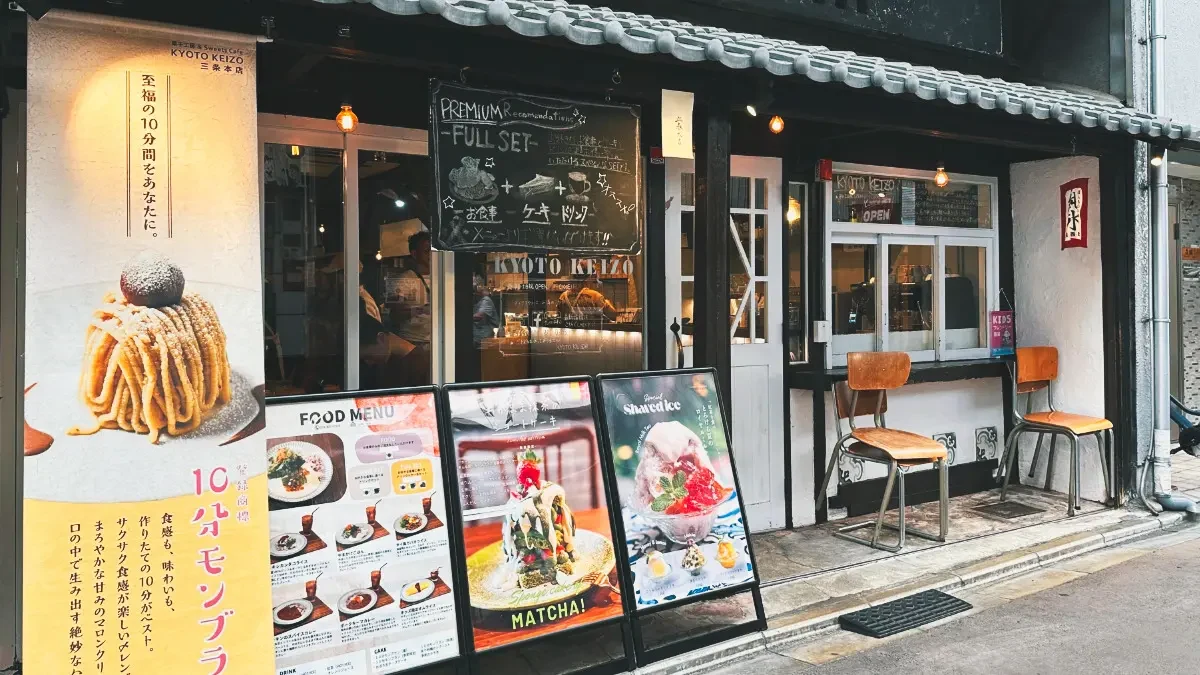
Approaching the Nijojo-mae side of Nakagyo-ku, Kyoto changes register. The temple-and-teahouse image softens into a working central district of small shops, family errands, and cafes that function as daily punctuation rather than destination theatre. In that setting, Sweets Cafe KYOTO KEIZO reads less as a grand sweets salon than as part of Kyoto’s quieter cafe grammar: cake, coffee, counter seats, sofa seating, an open terrace, and a room designed for short pauses as much as lingering afternoons.
Kyoto’s dessert culture is often reduced to matcha parfaits and wagashi near shrine gates, but the city’s cafe scene is broader and more urban than that shorthand allows. The strongest addresses in this category tend to sit between patisserie discipline and kissa practicality. They are places where a slice of cake can carry the same seriousness that another neighborhood gives to soba, yakitori, or kappo, without asking the guest to perform a fine-dining ritual. Sweets Cafe KYOTO KEIZO fits that middle lane: cafe and cake rather than restaurant tasting counter, selected for Tabelog 100 Cafe WEST in 2025, and priced for the kind of repeat local use that keeps Kyoto’s cafe culture honest.
Nakagyo-ku sweets culture without the shrine-gate script
Nakagyo-ku matters here. The district sits inside Kyoto’s central grid, close enough to the castle and shopping corridors to catch visitors, but local enough to avoid the single-product souvenir rhythm of the city’s more photographed lanes. That geography shapes the experience. A cafe in this part of Kyoto has to work for solo diners, families, neighborhood regulars, and travelers threading a day between subway stops. The format signals exactly that: non-smoking interior, counter seating, sofas, terrace space, and children welcome, including babies, preschoolers, school-age children, and strollers.
The useful comparison is not with Kyoto’s formal dining rooms, where reservations, course pacing, and chef hierarchy define the evening. It is with the city’s everyday specialty addresses, places where narrow focus builds credibility. On the savory side, a reader might look at 3TOKU6MI Shijo karasuma ten, 551蓬莱, [ki:], or Abbesses for different readings of central Kyoto dining. For sweets with older ritual weight, Aburi Mochi Honke Nemoto Kazariya belongs to a separate Kyoto lineage. KEIZO sits in the cafe-and-cake conversation instead: contemporary, casual, and judged by consistency rather than ceremony.
Tabelog’s 2025 Cafe WEST selection is the important trust marker. Japan’s cafe category is crowded, especially across Kansai, and inclusion in that list places the address among a curated regional group rather than merely among popular neighborhood stops. Its Tabelog score of 3.61 gives another signal: this is not a luxury-price room trading on scarcity, but a cafe with enough sustained approval to register in a competitive sweets market.
A cafe format that suits Kyoto's in-between hours
The appeal of this category is timing. Kyoto itineraries often break unevenly: an early temple, a late lunch, a shopping errand, a hotel check-in that leaves an awkward hour. A cake-focused cafe absorbs those gaps better than a full restaurant. KEIZO’s all-day cafe identity, its no-reservations policy, and its solo-dining friendliness make it more flexible than the city’s reservation-led counters. That comes with a trade-off: spontaneity is possible, but guests do not control the queue the way they might control a booked dinner.
Against local peers, the positioning is clear. Kissa Tirol works at a lower spend, closer to the everyday kissa bracket. Yoshokudo Suzuki overlaps at lunch pricing but reaches a higher dinner spend, making it a different decision. Torisho sai belongs to yakitori and a higher-price evening category. Singular and Miyawaki sit in the city’s broader restaurant conversation rather than the cafe-and-cake lane. KEIZO’s role is narrower and more useful: a sweets stop with award recognition, accessible pricing, and enough seating variety to serve different kinds of visitors without turning the visit into an occasion.
The planning logic is simple. Treat it as a central Kyoto cafe stop rather than a destination that should carry an entire day. Pair it with Nijo Castle, Shijo-Karasuma shopping, or a Nakagyo-ku afternoon where a seated break matters. Payment is flexible by local cafe standards, with credit card acceptance listed for AMEX and QR code payments accepted, while electronic money is not accepted. Parking is not provided, though coin parking is available nearby, which reinforces the better approach: arrive by subway, taxi, or on foot while moving through central Kyoto.
Where it belongs in a Kyoto food day
Kyoto rewards travelers who separate categories instead of forcing every meal to express tradition. A strong day might include a temple-adjacent sweet with centuries of habit behind it, a central cafe with cake and coffee, then a more structured dinner elsewhere. KEIZO is strongest in that second slot. It gives the day texture without demanding the budget, time, or formality of a tasting menu.
For wider planning, use Our full Kyoto restaurants guide to place it among the city’s dining options, then build the rest of the trip through Our full Kyoto hotels guide, Our full Kyoto bars guide, Our full Kyoto wineries guide, and Our full Kyoto experiences guide. Travelers comparing Japan’s casual cafe and specialist-food culture beyond Kyoto can also look at.cafe in Osaka,.know in Kumamoto, (Shoku) Vietnam in Kawasaki, [Curry Senmon Ten] Maruyama Kyoju. in Sapporo, -Grilled beef Sukiyaki- KAMAKURA TANUKIAN 鎌倉 たぬき庵 in Kamakura, and. 鮪と炭火焼き うお炭 秋葉原店 in Tokyo. For the North American side of Japanese casual formats, Jōdo Saké Bar in Los Angeles and Onigiri Time in Pasadena show how different cities translate focused Japanese food habits into their own dining rhythms.
The editorial case for Sweets Cafe KYOTO KEIZO is not that it replaces Kyoto’s classical sweets traditions. It shows another layer of the city: central, contemporary, practical, and serious enough about cake to earn regional cafe recognition. For a traveler who wants Kyoto between formal meals, that is the point.