Why go
Single origins, roasted on site
Everything here starts with one bean at a time. Coffees are bought from producing countries around the world, roasted on the machine in the room, and served as espresso, latte or French press, with no blends to hide behind. Roughly eight beans are open at any time, so a visit works as a comparison rather than a single order, and the bag you leave with is usually the one you have just tasted.
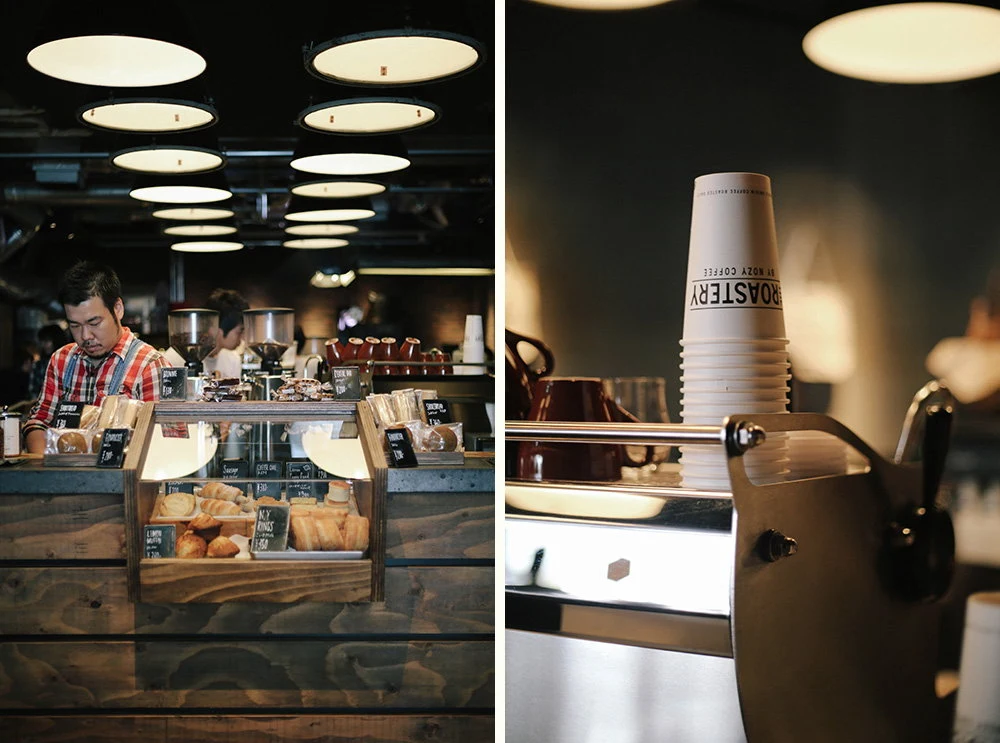
That structure makes the retail shelf part of the drink menu instead of a sideline. The roasting machine sits in view rather than behind a wall, which is the clearest statement the shop makes about where its attention goes: origin, roast and the way the two read across three brew formats.
A Harajuku coffee bar off Cat Street
The shop sits in Jingumae, near Cat Street, one of Tokyo’s more fashion-conscious pedestrian runs, and it holds its own against that backdrop with a bold, hard-edged room rather than a soft one. It reads as a hybrid: drink bar, roastery, bean shop and somewhere to learn, all working off the same counter.
Service is part of the concept. Conversation across the bar is how guests get steered between beans, between espresso and French press, and toward what to take home, so the staff matter more here than in a room where the menu board does the deciding. In a city with no shortage of cafés, the single-origin-only rule, the in-house roasting and that guided approach are what mark it out. It was named to the Tabelog 100 for 2025 at No. 62.
What to order
Order by deciding how you want to read the bean. Espresso is the most concentrated look at a single origin, short and unforgiving. Latte takes the same coffee into milk, which is useful when you want the origin character softened by sweetness and texture rather than stripped back.
French press is the slow option and the one that gives the fullest sense of body and depth, so it suits a longer sit and a bean you already like. If you are buying for home, treat the visit as a tasting: work through two or three of the beans on offer, decide what you actually want in the morning, and buy that. The most distinctive order is not a fixed signature drink but a sequence, an origin, then a format, then the next bean.
Tags
Frequently asked questions
What should I order at THE ROASTERY BY NOZY COFFEE?
Choose an origin first, then a format. Espresso gives the most concentrated read on a single-origin coffee, latte softens it through milk, and French press draws out body and depth. With around eight beans open at a time, most visits work best as a comparison across two or three.
Can you buy beans at THE ROASTERY BY NOZY COFFEE?
Yes. Coffees are roasted on the machine in the room and sold at the same counter, so the retail shelf matches what is being poured. Around eight single origins are available to taste before buying, and staff will talk through the differences between them and the brew method that suits each.
Compare nearby places
| Venue | Type | Area |
|---|---|---|
| STREAMER COFFEE COMPANY SHIBUYA | Café | Shibuya |
| All Seasons Coffee | Café | Shinjuku |
| UNISON TAILOR Coffee and Beer NINGYOCHO | Café | Nihonbashi Ningyocho |
| STARBUCKS RESERVE ROASTERY TOKYO | Café | Nakameguro |
| Premarché Gelateria Toukyou nakameguro ekimae ten | Café | Nakameguro |