Why go
Dallmayr coffee and tea are the reason to sit down here, in the Osaka café and shop that carries the Munich house into Japan.
Coffee and tea set the programme
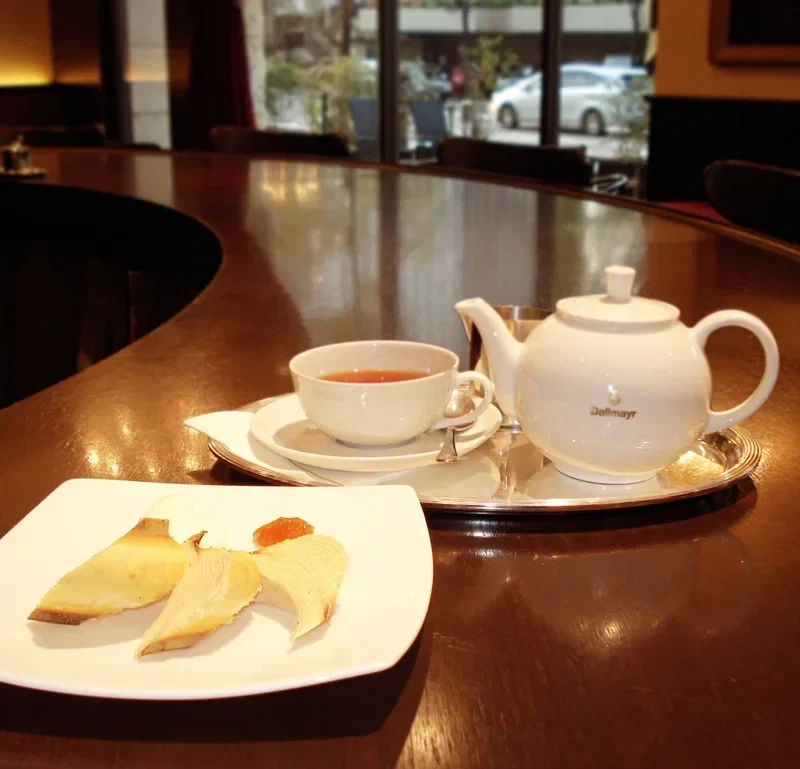
Cafe AMADEUS STORY is Dallmayr’s Osaka expression, and the Munich story gives the room its context: a grocery from 1700, more than three centuries of trade, and a reputation strengthened around 1900 when the Bavarian royal house and the German Emperor made it a court supplier. Coffee and tea are not incidental here. The coffee is defined by sourcing and roasting rather than a list of espresso drinks, with beans acquired through long-established routes and finished by traditional roasting for aroma. Tea gets equal weight, with leaves chosen from leading gardens, shaped by expert blending and held to the same quality control. An original Japanese black tea sits in the range alongside the European blends.
A café and shop in one room
Read it as a café and shop built around imported food culture rather than a chef-led restaurant. Guests come for Dallmayr coffee and tea served with the house’s own idea of service, then stay to look at the carefully selected foods from Europe and Japan on the shelves. What holds it together is the system behind the brand: selective purchasing, traditional roasting, blending by specialists, and quality control applied at each step. Food is complementary rather than a full kitchen operation, with a pretzel sandwich among the savoury options and the rest of the assortment chosen from the same European and Japanese sources. In Osaka’s café landscape it fills a specific niche, a European heritage house for coffee drinkers, tea drinkers and anyone browsing for something to take home.
Order the tea, then browse the shelves
Begin with whichever pillar suits the hour: Dallmayr tea for leaves selected from leading gardens, or Dallmayr coffee for the sourcing and the roast. Tea is treated with as much seriousness as coffee here, which is unusual enough to be a reason to choose it, and the original Japanese black tea is the version that belongs to this room rather than to Munich. The pretzel sandwich is the straightforward savoury order beside either. After that the visit becomes a browse: the selected European and Japanese goods are part of the point rather than a gift-shop afterthought, and the classical tone of the name matches the register of the room.
Tags
Frequently asked questions
What should I order at Cafe AMADEUS STORY?
Tea or coffee, both of which come from Dallmayr and are treated with equal seriousness. The original Japanese black tea is the version particular to this room rather than to Munich, and the pretzel sandwich is the straightforward savoury order beside either. Then browse the selected European and Japanese goods.
Is it a café or a shop?
Both, in one room. Guests sit for Dallmayr coffee and tea, then look through the carefully selected foods from Europe and Japan on the shelves. Food service is complementary rather than a full kitchen, so the visit works best as a drink followed by a browse for something to take home.
Compare nearby places
| Venue | Type | Area |
|---|---|---|
| MOTO COFFEE | Café | Kitahama |
| Bird COFFEE | Café | / Tsurumi-ku |
| wad omotenashi cafe | Café | Shinsaibashi / Minamisenba |
| Le Premier Cafe Shinsaibashi honten | Café | Shinsaibashi |
| cocoo cafe | Café | Hommachi / Utsubo Park area |