Why go
Additive-free natural yeast, French method
The counter at Boulangerie 14 Ku is built on hard-style bread made with additive-free natural yeast, which is the fastest way to read the shop. Baguettes, shokupan-style loaves and other naturally leavened breads carry the emphasis on fermentation, crust and crumb, while the softer side is handled by a croissant made with domestic fermented butter and a melon pan made with the same butter. The chef trained for two years in Paris and spent a further seven years working in France, and the range shows it: French technique applied at the scale of a Yokohama neighbourhood bakery, with Japanese favourites kept in the case rather than pushed aside. The bakery was named to the Tabelog 100 in 2022.
Eleven seats and a red awning
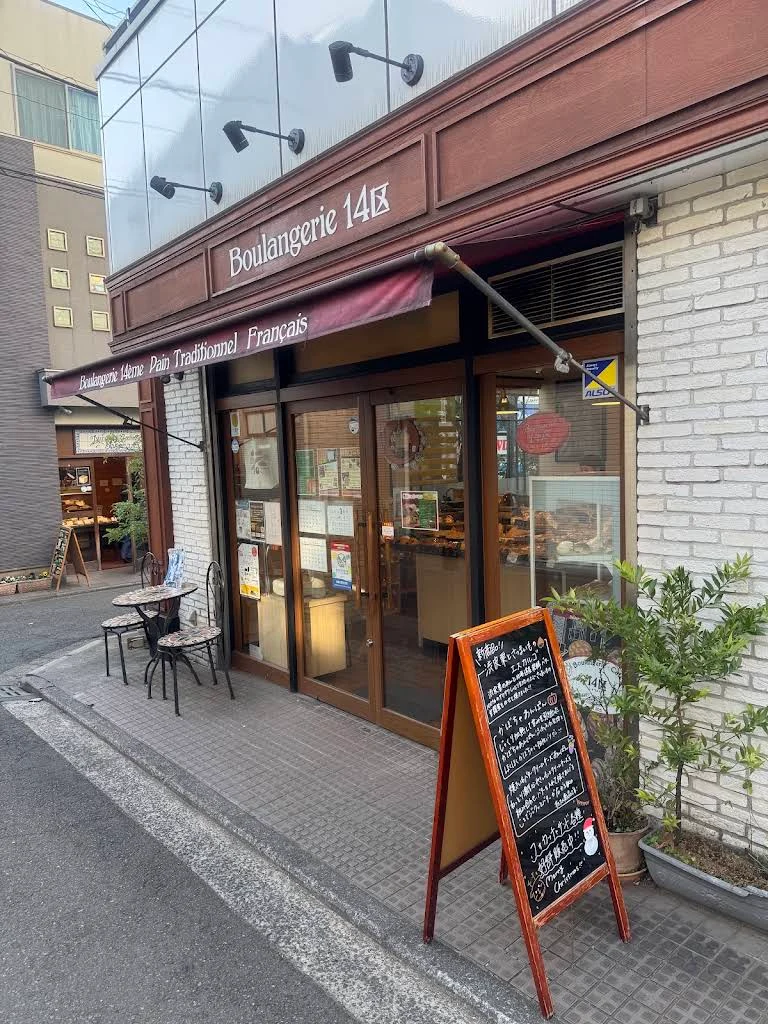
The room is small in a literal way: eleven seats, made up of two four-person tables and three places at the counter. That footprint puts it closer to a neighbourhood boulangerie with a café corner than to a bakery restaurant, and it keeps attention on what comes out of the oven. Outside, a red awning marks the shop along the local Kikuna shopping street, a plain street-level signal rather than a grand frontage. Coffee is served alongside the bread, which is what makes the corner a café rather than only a bakery. The visit is product-led: read the case, choose, sit down for a coffee if a seat is free, or carry the bag home.
Baguette first, then the butter side
Begin with the baguette or another additive-free natural yeast loaf, since those give the clearest read on the bakery’s French training. They depend on dough handling, fermentation and bake rather than filling or decoration, so the work has nothing to hide behind. A shokupan-style loaf is the useful second benchmark: the same bread-first thinking translated into the soft, everyday Japanese format most households actually buy.
Then move to the butter. The croissant made with domestic fermented butter is the key laminated item, richer and more fragrant than a standard version, and the melon pan brings that same butter into a familiar sweet bread under a crisp cookie top. A single order can therefore cover the whole shop: a natural yeast bread for the craft, a loaf for daily eating, then croissant and melon pan for the butter-led side of the counter.
Frequently asked questions
What is the bread programme at Boulangerie 14 Ku?
Hard-style breads made with additive-free natural yeast are the core, including baguettes and shokupan-style loaves, and they are where the chef’s French training shows most clearly. Alongside them the shop bakes a croissant and a melon pan with domestic fermented butter, so the case runs from French staples to Japanese favourites without losing its bread-first focus.
Can you sit down at Boulangerie 14 Ku?
Yes, but only just. There are eleven seats in total, two four-person tables and three counter places, so the shop works best as a bakery you buy from with the option of staying. The scale keeps it in neighbourhood boulangerie territory rather than making it a full bakery café.
Compare nearby places
| Venue | Type | Area |
|---|---|---|
| Patisserie Les Bien Aime | Bakery | Naka-ku / Ishikawacho |
| TOAST neighborhood bakery | Bakery | Naka-ku |
| ECHIRE PATISSERIE AU BEURRE Yokohama takashimaya ten | Bakery | Nishi-ku |
| BLUFF BAKERY Motomachi honten | Bakery | Motomachi |
| patisserie IKEDA | Bakery | Tsuzuki-ku |