Why go
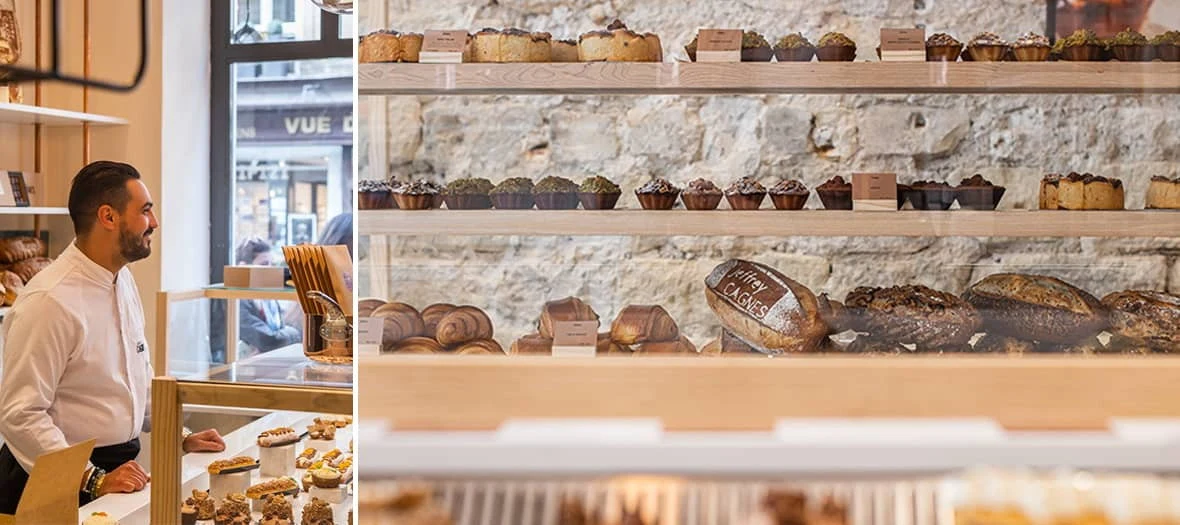
The case is the argument here: tarte citron, flan in three flavours, a honey-laminated croissant and the layered Cupra Chocolat, set out so the pastry does the talking. Jeffrey Cagnes runs the maison under his own name, and its motto, “le goût de l’essentiel,” reframes classic technique through personal memory, Mediterranean roots and a contemporary style.
A calm Paris pâtisserie
The Rue Montorgueil shop, added in December 2022, brought modern French pâtisserie to one of the city’s emblematic food streets. The mood is warm and understated: deep blue accents, large windows and a compact interior where the pastries take the focus. It works as a pâtisserie stop rather than a long café meal, with guests browsing viennoiserie, tarts, flans and cakes before leaving with a box.
That rhythm fits Cagnes’s background. Before opening his own maison he revived classics including baba au rhum and puits d’amour at Maison Stohrer, then worked with Jean-François Piège. The shop keeps that heritage visible in a cleaner, more personal register, built around signatures: tarte citron, croissant, flan pistache, flan noisette, flan vanille, tarte aux fraises and Cupra Chocolat.
What the case is actually made of
Tarte aux fraises combines pâte sucrée, vanilla crémeux, strawberry confit and mascarpone chantilly. Cupra Chocolat layers 64% dark chocolate mousse around crisp almond-hazelnut praline and chocolate biscuit on a vanilla sablé. The croissant shows the same care: honey in place of sugar, and Lescure butter, giving deep lamination, a crisp shell and a tender interior. The wider range moves with the seasons through fruit tarts, cakes, limited editions and holiday pastries.
Beyond pastry and viennoiserie there is a Coffee Club line of revisited sandwiches, but the shop stays pastry-led. A second, design-led counter pairs haute pâtisserie with limited-series creations, minute pastries and a barista experience that sets Cupra Chocolat against a double espresso or a specialty latte.
Order the citron first, then decide how much chocolate
Start with the citron tart. It is the clearest signature because Cagnes links it directly to his mother, making it both a personal benchmark and the classic-meets-modern expression of the house. His broader flavour language draws on the same family memory, and on milk, honey and orange blossom.
The croissant is the simplest way in, the quickest read on lamination, honey and French butter. Flan pistache, flan noisette and flan vanille offer three custard-led directions, while tarte aux fraises adds fruit, confit and chantilly. For chocolate, Cupra Chocolat is the one to take: dark mousse, nut praline, chocolate biscuit, vanilla sablé. With little seating and a mostly takeaway rhythm, the sensible plan is a precise box rather than a long sit.
Frequently asked questions
What should you order at Jeffrey Cagnes?
Start with the tarte citron, the signature Cagnes ties to his mother and the clearest read on the house style. The croissant, made with honey in place of sugar and Lescure butter, is the simplest second choice, and Cupra Chocolat is the one for chocolate: dark mousse, almond-hazelnut praline and vanilla sablé.
What goes into the Cupra Chocolat?
Cupra Chocolat layers 64% dark chocolate mousse around a crisp almond-hazelnut praline and chocolate biscuit, all set on a vanilla sablé. It is the chocolate signature of the maison and also appears at the design-led second counter, where it is paired with a double espresso or a specialty latte.
Compare nearby places
| Venue | Type | Area |
|---|---|---|
| Mandipili | Bakery | 2nd arrondissement |
| Substance Café | Café | 2nd arrondissement |
| TOMO | Bakery | Opéra / 2nd arrondissement |
| Maison Fleuret Paris | Bakery | Saint-Germain-des-Prés |
| La Maison du Mochi | Bakery | Paris IIIe / Le Marais |