Why go
Fruit and season in Claire Damon’s hands
Fruit and the vegetal, in season only: that is Claire Damon’s stated signature at Des Gâteaux et du Pain, her Paris pâtisserie and boulangerie. The constraint is what makes the case worth returning to, because it forces the roster to move rather than settle. Behind it sit small producers, French organic free-range eggs, and a production range that runs from pastries and viennoiseries to breads, cakes and sablés.
The bread half is not an afterthought. Naturally leavened loaves sit alongside the pastry work, made in the same house and to the same standard, which is why the name gives cakes and bread equal billing. The result is a bakery-pâtisserie rather than a café, where the reason to come is the display and what you take away from it.
A black boutique, and pastry set out like jewellery
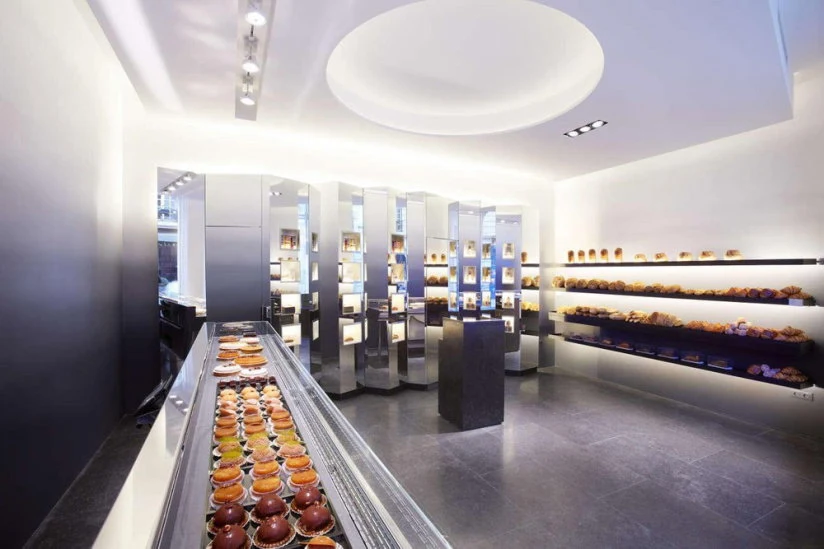
The shops are done in black, with dark walls and an elegant typeface that read closer to a luxury boutique than a neighbourhood bakery. The effect carries into how the pastry is presented, arranged with the spacing and lighting of jewellery rather than stacked in a case.
That visual language suits the product. Baba à la fraise arrives with strawberry syrup, J’adore la Fraise pairs strawberry cream with fresh strawberries, chou rhubarbe puts rhubarb cream and poached rhubarb into crisp choux, and tarte jardin fraise is built on sablé, biscuit cuillère, kirsch and vanilla mousseline. The green absinthe tart is one of the house’s best sellers, and the chausson aux pommes is the piece to take when the visit lands closer to breakfast. It is a precise retail encounter rather than a room to linger in.
Follow the signatures, then the season
Start with one of the fixed points: baba à la fraise, J’adore la Fraise, chou rhubarbe, tarte jardin fraise or the green absinthe tart. Any of them shows Damon’s liking for acidity, fruit and layered texture without needing an explanation.
Then read the seasonal pieces, which is where the kitchen gets more ambitious. Kashmir combines saffron, orange, vanilla, almond biscuit, organic Italian orange compote, saffron crème brûlée, Madagascan vanilla mousse and Deglet Noor dates. Pamplemousse Rosa uses Corsican grapefruit cream and segments, a rose-flavoured rice flour biscuit and rose de Grasse mousse. Bâton de Rhubarbe, Biscuit de Savoie Glacé, sablés spéculoos and L’Exubérante pêche, with white peaches, fresh French organic verbena and Provence almonds, come and go with what is good. Pomme tatin with maple syrup is the other reliable choice, and bread is worth taking on the way out.
Frequently asked questions
What should you order at Des Gâteaux et du Pain?
Start with a fixed signature: baba à la fraise, J’adore la Fraise, chou rhubarbe, tarte jardin fraise or the green absinthe tart. Each shows Claire Damon’s liking for acidity and layered fruit. Then look at the seasonal pieces, such as Kashmir or Pamplemousse Rosa, and take bread on the way out.
Is Des Gâteaux et du Pain a bakery or a pâtisserie?
Both, and the name says so. Naturally leavened breads are made in the same house as the pastry and held to the same standard, so the boulangerie side is not a sideline. What unites them is Damon’s stated signature of fruit and the vegetal, used only when they are in season.
Compare nearby places
| Venue | Type | Area |
|---|---|---|
| Pâtisserie Toshiya Takatsuka | Bakery | 15th arrondissement |
| Pierre Hermé | Bakery | Saint-Germain-des-Prés |
| Méert | Bakery | Le Marais |
| Carette | Bakery | Trocadéro |
| Café Pierre Hermé | Bakery | 7th arrondissement |