Why go
Setteveli, and the technique behind it
Setteveli is the cake that explains this house: dark chocolate mousse over hazelnut praline bavaroise, seven thin veils of chocolate, and a crunchy cereal base that keeps the whole thing from going soft. Luigi Biasetto, who won the World Pastry Cup in 1997, opened the Padua boutique in 1998 after training in Belgium, and the shop has always described itself as an atelier rather than a pastry shop. It stands just outside the historic centre, near the Basilica of Saint Anthony, and the renovated interior reads as a working laboratory with a retail counter attached rather than a neighbourhood bakery. Biasetto has also taught, written and served in professional pastry associations, and the case reflects that discipline. Gambero Rosso awarded the shop Tre Torte for 2026, and it is a member boutique of Relais Desserts.
A counter that runs wider than cake
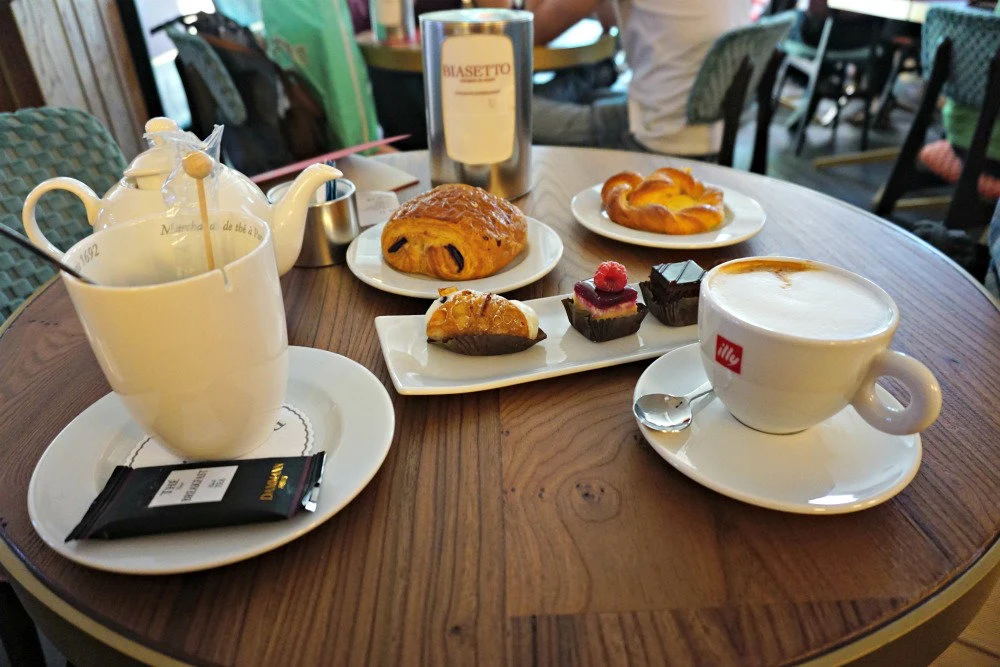
The range is broad without losing its centre. Alongside the entremets there are macarons, mignons, petits fours, pralines and fancy biscuits; breakfast viennoiserie including croissants and sfogliatelle; gelato; travel cakes and plum cakes; fruit jellies, jams and spreads; vegan items and chocolate drinks; and a savoury line that runs to aperitivo pieces. Named work is worth knowing: Setteveli Voyage, a summer panettone, a savoury panettone with herbs, and another with confit tomato and pesto. Pizzuta is a chocolate cake built like a pizza, made with chocolate frangipane and hazelnuts. Around Christmas the leavened baking takes over, with panettone and pandoro carrying much of the shop's reputation.
How to work the shop
Order Setteveli first, then go small. Mignons, macarons and pralines let you read more of the counter without committing to a second whole cake, and they show the same precision at a scale you can eat standing. The layout supports that progression: mini-cakes, mignons, pralines and macarons on one side with the till, croissants and the coffee bar beyond them, the pastry laboratory visible ahead, and long tables with stools opposite. The tea room at the back is the calmest part of the shop, with a 1970s tilt to the furniture. At breakfast the croissants belong in the order. For a gift, panettone, pandoro, chocolates, fruit jellies, jams or travel cakes reflect the retail side better than a single plated pastry.
Frequently asked questions
What should I order at Biasetto?
Setteveli first: dark chocolate mousse, hazelnut praline bavaroise, seven thin chocolate veils and a crunchy cereal base. After that, go small with mignons, macarons or pralines, which show the same precision in a single bite. At breakfast the croissants are the order; around Christmas, panettone and pandoro take over the counter.
Can you sit down at Biasetto?
Yes. There is a tea room at the back, the calmest part of the shop, along with long tables and stools near the front and a coffee bar beside the croissant counter. The pastry laboratory is visible from the room, so the production side stays part of the visit rather than hidden behind it.
Compare nearby places
| Venue | Type | Area |
|---|---|---|
| Pasticceria Marisa | Bakery | San Giorgio delle Pertiche |
| Forno Veneziano | Bakery | Piazza Vittorio Emanuele II |
| Tocio di Giulia Busato | Bakery | Noale |
| Opera | Bakery | — |
| Grigoris The Bakery | Bakery | Mestre Centro |