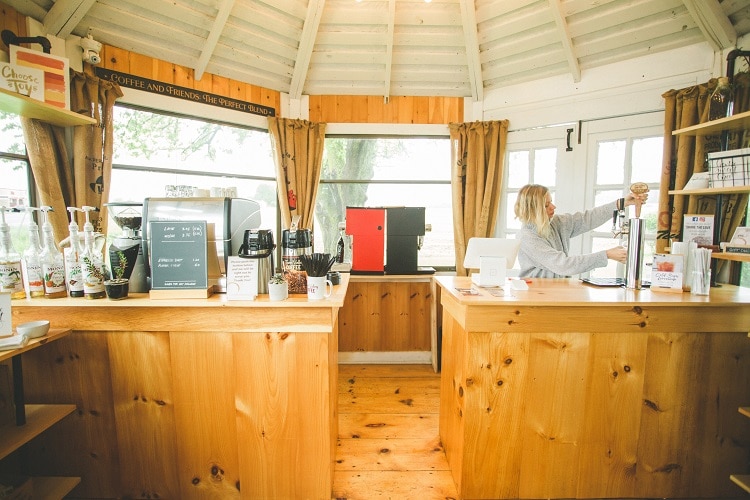
At the new Main Street cafe, the old gazebo sits in the courtyard while nine shipping containers carry the building around it. Twin Valley Coffee Elverson is the June 2026 Main Street cafe from the family-owned roaster founded by Lynn Burkholder in 2005, built in a Pennsylvania town of 1,322 residents (Sprudge).
That preserved gazebo gives the new building its first read. Before the containers, before the four-group La Marzocco GB5 AV, before five cafes carried the Twin Valley name, Burkholder roasted coffee in a hot-air popcorn popper. The business moved from that first roasting habit to a roadside stand, then to the front-yard gazebo that regulars learned as a coffee stop. Now the company has returned to the original site with a building designed by Mark Myers, a courtyard organized around memory, and a counter built for service at a larger pace (Sprudge).
Twin Valley Coffee Elverson: Nine Containers, One Gazebo
Elverson sits east of Philadelphia, on the way toward Lancaster, and the population number matters here. A town of 1,322 does not absorb a new cafe the way a city block does. A new Main Street building becomes part of the town’s daily route, part of the school-run map, part of the weekend loop for people who plan their errands around coffee.
The new Twin Valley Coffee Elverson cafe uses nine shipping containers. Mark Myers, of Mark C. Myers Architects, designed around the containers rather than treating them as a stack of metal boxes. That detail changes the reading of the space. The containers are the structure, but the courtyard carries the origin story. Large windows open toward that courtyard, where the original gazebo has been preserved (Sprudge).
Nicole Weisman, speaking for Twin Valley Coffee in Sprudge’s Build-Outs of Coffee feature, described the gazebo as a beautiful reminder of where the company has been. The phrase could have floated away as cafe copy if the gazebo had been rebuilt as decoration. Here, the old structure remains on site, in the new cafe’s daily sightline. Customers can stand in the courtyard and see the practical distance between the company’s first service point and its current one.
The container count gives the building its headline. The gazebo gives it its weight. In a town this small, that combination turns a cafe opening into a piece of Main Street infrastructure, with the founder’s first service point still visible from the new room.
From a Hot-Air Popper to Main Street
Lynn Burkholder founded Twin Valley Coffee in 2005. The first tool in the story was not a production roaster. It was a hot-air popcorn popper. That origin has become part of the company’s working language because it keeps the scale legible. Roasting began with a small, improvised setup, then grew into a roadside stand, then the front-yard gazebo.
The company now operates five cafes and roasts all of its coffee in-house at a local production facility. It also brews its cold brew there and supplies wholesale partners. Those facts matter because a family coffee business can grow in two different directions. It can become a brand with cafes attached, or it can keep production close enough that each cafe still answers to the roasting side of the company. Twin Valley has built the second version, at least in the facts it makes visible: local production, in-house roasting, cold brew made under the same roof of operations, and a new flagship tied to the original site.
The signature order is the Signature Cold Brew. That drink carries the company’s registered phrase, Your life is about to change®. The phrase began in the gazebo years, when Burkholder served the cold brew to first-time customers. It is easy to be skeptical of a line that polished. The saving detail is the handoff. A founder sliding a cold brew across a gazebo counter gives the phrase a specific source, and regulars repeated it before it became a piece of company language.
At the new Twin Valley Coffee Elverson cafe, order the cold brew first if you want the shortest route into the company’s history. Order an espresso second if you want to see the new room working at full mechanical scale.
Mark Myers Designs Around the Containers
Shipping-container cafes often risk looking like the construction method came before the hospitality. At Main Street, the design problem was different: how to use nine containers without letting the metal shells erase the property’s earlier life. Myers designed the space around the containers, and the plan gives the interior a more open feel than the small footprint might suggest.
The courtyard does some of that work. Large windows face it, and the preserved gazebo keeps the eye from stopping at the container walls. The building looks outward toward the original service point, which turns the courtyard into a kind of working archive. It is part of the route through the cafe, and it gives the customer a physical before-and-after without a plaque needing to explain it.
Myers also had to treat the containers as building units with limits. A container arrives with fixed proportions and a history as cargo infrastructure, not as a room meant for people lingering over cold brew. Cutting, joining, insulating, and finishing those units requires decisions that ordinary cafe build-outs can hide inside drywall. D. Howe and Sons built the project, turning a non-standard build into a functional cafe. Lynn Godshall of GCI Design handled the interior design, translating the family’s sense of the place into the finished room.
The useful lesson for coffee operators is not that every town needs a container cafe. It is that an unusual build has to answer the counter first. Can the bar team move? Can customers understand where to order? Can a small room breathe when the morning rush hits? The Main Street project puts those questions inside a structure that also preserves the gazebo, which is the harder move.
The Four-Group GB5 at the Counter
The bar at Twin Valley Coffee Elverson centers on a four-group La Marzocco GB5 AV espresso machine. Twin Valley uses La Marzocco espresso equipment across all of its cafes, and the Main Street machine gives this location a piece of hardware with its own coffee-world footnote: it is one of the last four-group GB5s La Marzocco ever built (Sprudge).
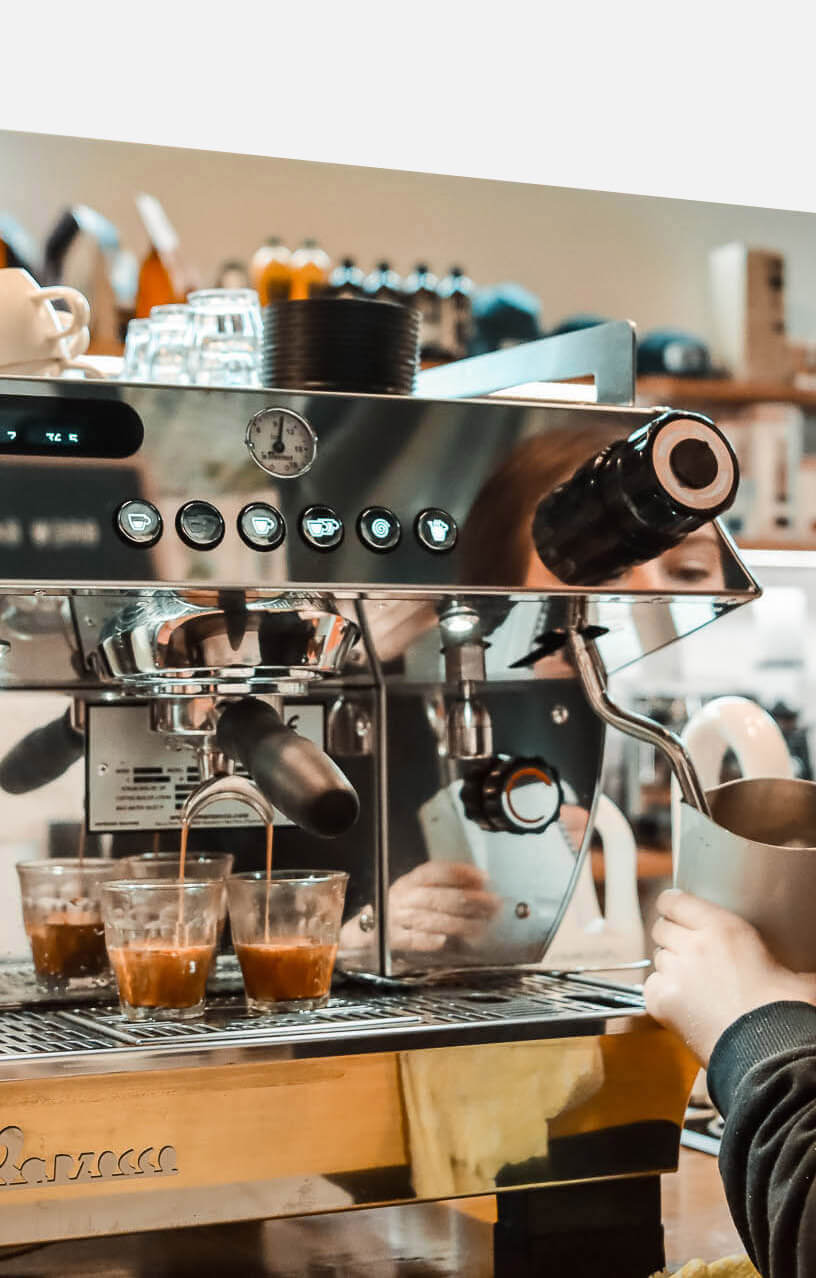
A four-group machine signals expected volume. It also changes the rhythm behind the bar. Four groups let the team stagger shots, keep milk drinks moving, and protect service flow when the line stacks up. The AV model brings volumetric dosing to that workflow, useful in a company that runs multiple cafes and wants consistency across counters.
That machine also gives the new cafe a scarcity detail that coffee people will notice. La Marzocco’s GB5 has long been a familiar silhouette behind espresso bars, but the four-group version at Main Street sits near the end of that production line. For a company whose first roast came out of a hot-air popcorn popper, placing one of the last four-group GB5s at the new counter reads as a clear equipment choice rather than decoration.
The useful confirmed fact is simpler: the company roasts its own coffee and puts that coffee through La Marzocco equipment at each cafe. For a visitor, that means the espresso order at Main Street is not a guest-roaster cameo. It is Twin Valley’s own roasting work passing through one of the last four-group GB5 builds.
Ask for espresso if the bar is moving and you want to watch the machine earn its footprint. Ask for the Signature Cold Brew if you want the drink tied to the gazebo years. Those are the two orders that explain the place without asking the menu to do too much.
Roasting In-House Across Five Cafes
Twin Valley Coffee now serves guests at five cafes. The company also supports wholesale partners, which puts pressure on the production side: roast enough coffee for retail counters, wholesale accounts, and cold brew without losing the recognizable house line that regulars expect.
The company roasts all of its coffee in a local production facility. It also brews all of its cold brew there. That structure matters for a cafe group because cold brew can become a separate product category with its own drift. At Twin Valley, cold brew remains tied to the same production identity as the roasted coffee. The gazebo served cold brew, and every cafe now has cold brew on tap.
The Main Street cafe therefore reads as both a retail room and a family archive. The roasting is not visible in the details published for the new space, but the building keeps pointing back to production: the popper in 2005, the roadside stand, the gazebo, the five cafes, the local facility. The story is not a straight line from small to large. It is a set of repeated service decisions made visible through architecture.
There is also a neighborhood lesson here. Small-town coffee culture works differently from destination coffee in a large city. In Elverson, the cafe has to serve the regular who has known the gazebo, the first-time customer hearing the cold brew line, and the traveler pulling off the route between Philadelphia and Lancaster. The container building gives those groups a clear signal from the street, while the preserved gazebo gives longtime customers something older than the opening month.
How to Visit the Main Street Cafe
The Main Street cafe opened in June 2026. Current hours should be checked directly with Twin Valley Coffee before the drive, especially for travelers building a morning around the stop. The better plan is to go early in the day, order the Signature Cold Brew first, then stay long enough to watch the espresso bar work on the four-group GB5 AV.
If you care about cafe architecture, take the courtyard seriously. The preserved gazebo is the object to look for, and it explains the project faster than a wall of brand language could. Stand where the windows face it and the building’s logic comes into focus: nine containers make the new room possible, but the older structure tells you why the company came back to this site.
For coffee buyers and cafe operators, the practical questions are different. Watch how the team uses the counter. Look at how the room handles a line. Pay attention to whether the container construction feels like a constraint or a frame for service. A cafe build-out earns its keep in those small repetitions: the reach from grinder to grouphead, the handoff at the bar, the customer who knows where to wait without being told twice.
Twin Valley Coffee Elverson gives its town a Main Street cafe with a visible lineage: Lynn Burkholder’s 2005 popper, the roadside stand, the gazebo, five cafes, in-house roasting, and a nine-container return to the original site. The next test is daily use, the kind measured in cold brew taps pulled, espresso shots timed, and regulars who still recognize the old gazebo from the courtyard.