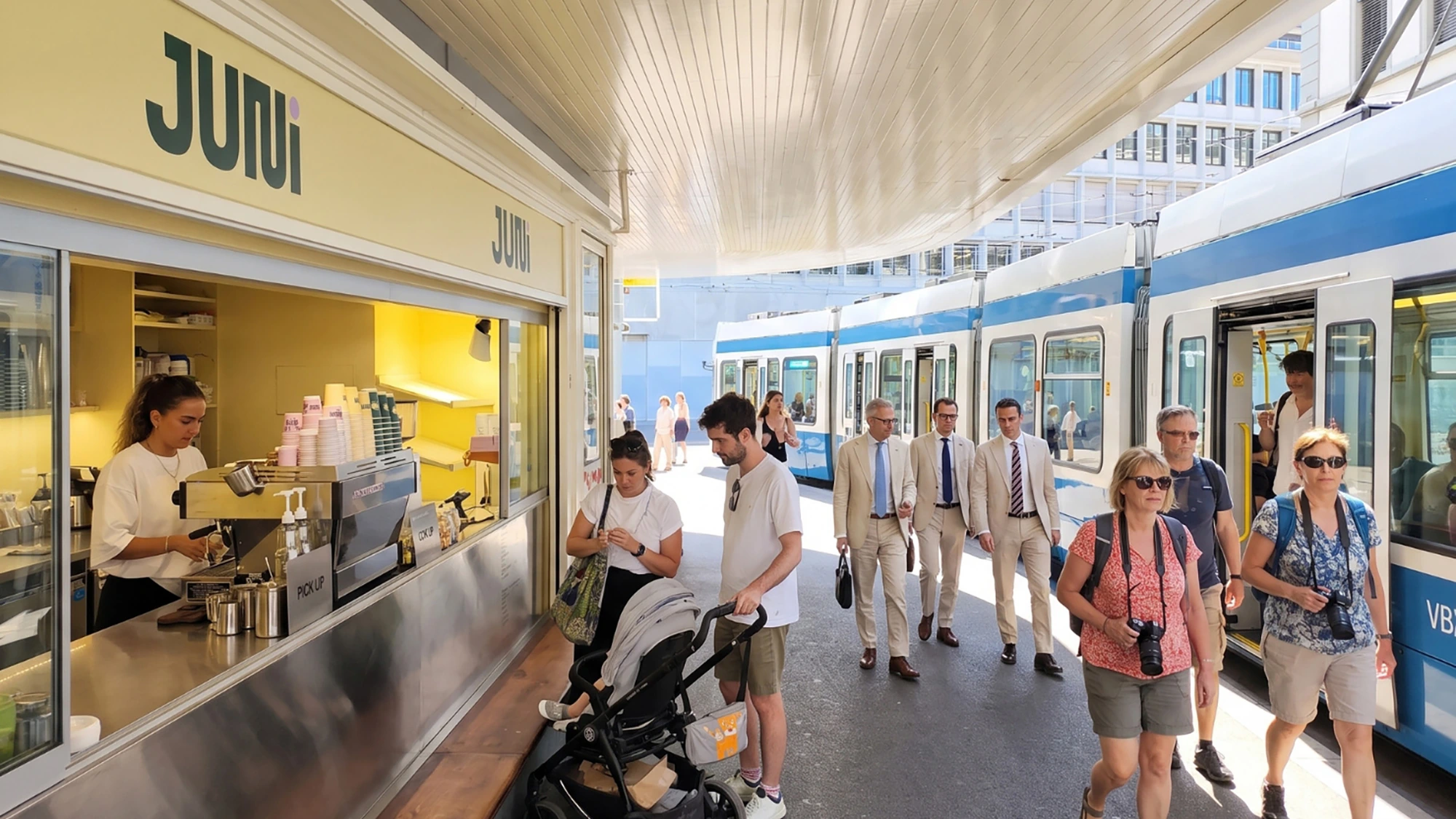
At the Kunsthaus tram shelter, the order is now a flat white or a matcha latte handed across the old kiosk counter. At Kreuzplatz, Miró Manufactura de Café pours batch brews and cappuccinos from another tram pavilion. VBZ, Zurich’s public transport operator, chose not to renew all expiring kiosk leases and put some of them back out to tender, which opened these small, high traffic rooms to coffee operators built for the commute.
The old kiosk had a clear job at tram stops and railway stations: newspapers, magazines, tobacco, alcohol, snacks, lottery tickets, a quick handoff before the next train. That model has come under pressure as news has moved to phones and alcohol and tobacco sales have faced stricter regulation. Food and drink concepts designed for short waits and takeaway use have gained ground. By the end of that chain, coffee is no longer just near transit. In Zurich, Basel, Copenhagen, and London, specialty coffee is becoming part of the transport fabric itself.
Why Transit Coffee Kiosks Are Taking Over the Old Stand
Judith Setz, media spokesperson for VBZ, put the change in plain terms: “Demand for high-quality coffee, snacks, and takeaway offerings has increased significantly in recent years, while demand for traditional kiosk products such as newspapers and magazines has declined significantly.” VBZ’s tender process asked operators to answer those changing needs rather than continue every old lease by default.
The kiosk is a strict format. It works with short dwell time, small storage, quick handover, and a public operator’s need for concepts that can serve a wide daily stream without turning the stop into a destination-only room. Coffee fits that shape when the menu stays focused. Espresso drinks, batch brew, matcha lattes, and takeaway cups can sit inside the same footprint that once held newspapers and regulated products.
VBZ treated that swap as a core part of the decision. Product quality and the overall concept were decisive in the tender, and operators had to respond clearly to “to go, specialty coffee, snacks” while offering added value. Fabian von Rechenberg, one of the co-founders of Mops, said Mops, the Juni coffee window, and Murphy’s won the tender because “we have a local and sustainable concept that works.” He also said Zurich’s public transport operator could not speculate on high turnover rents or riskier niche concepts that had not established themselves.
That is the inside mechanic behind the counter change. Public transport tenders are shaping who pours coffee in historic kiosk spaces. The craft question sits inside a property question: which operators can make a compact, fast, quality-focused format credible enough for transit infrastructure?
Zurich Shows How Specialty Coffee Enters the Commute
Mops gives the shift its cleanest Zurich example. The Kunsthaus tram shelter pavilion has housed a kiosk since 1911 and is locally nicknamed the überfütterte Mops, or overfed pug, because of its oversized roof. Since March, the pavilion has been home to Mops, a specialty coffee cafe named after that nickname.
The product change is direct. The pavilion no longer centers newspapers, tobacco, and alcohol. Mops serves flat whites, specialty coffee, matcha lattes, and takeaway drinks from the historic tram shelter. Von Rechenberg is one of the co-founders, and his wider group of cafes, Mops, the Juni coffee window, and Murphy’s, sits inside the tender story that brought specialty coffee operators into these locations.
The building still carries its older civic functions. The Kunsthaus pavilion includes a public toilet and seating, and it stands at the Kunsthaus stop. The cafe did not arrive in a blank retail shell. It moved into a tram shelter with a local nickname and a kiosk history more than a century long.
Miró Manufactura de Café gives Zurich a second tram shelter proof point. At the end of April, Miró opened its fourth cafe at the Kreuzplatz tram shelter, a pavilion built in 1918 by architect Friedrich Fissler. Fissler also designed the overfed pug pavilion at Kunsthaus. Decorative wall paintings remain in the Kreuzplatz shelter and tell the story of the surrounding neighborhood.
Dani Sanchez founded Miró with his brother David Sanchez in 2013. The Kreuzplatz site serves batch brews and cappuccinos inside the historic pavilion. Dani Sanchez said tram stations are ideal for convenience consumption because they have a constant flow of people, and he also pointed to the established neighborhood around the location as important to Miró.
Zurich’s two examples show how the city’s operators are filling rooms with a different kind of service. VBZ put leases out to tender to respond to changed demand. Mops and Miró occupy places that used to serve the old kiosk economy, and each brings an established coffee operator into the room. Transit coffee kiosks here are not pop-ups. They are the current tenants of long-standing transport infrastructure.
Basel, Copenhagen, and London Widen the Map
Zurich is the sharpest case because the tender process is explicit, but the same pressure appears elsewhere in different forms. In Basel, Kaffeemacher has opened a two-story cafe inside the Swiss Federal Railways station, the city’s main railway station. The company serves coffee there and offers specialty coffee courses in the station cafe.
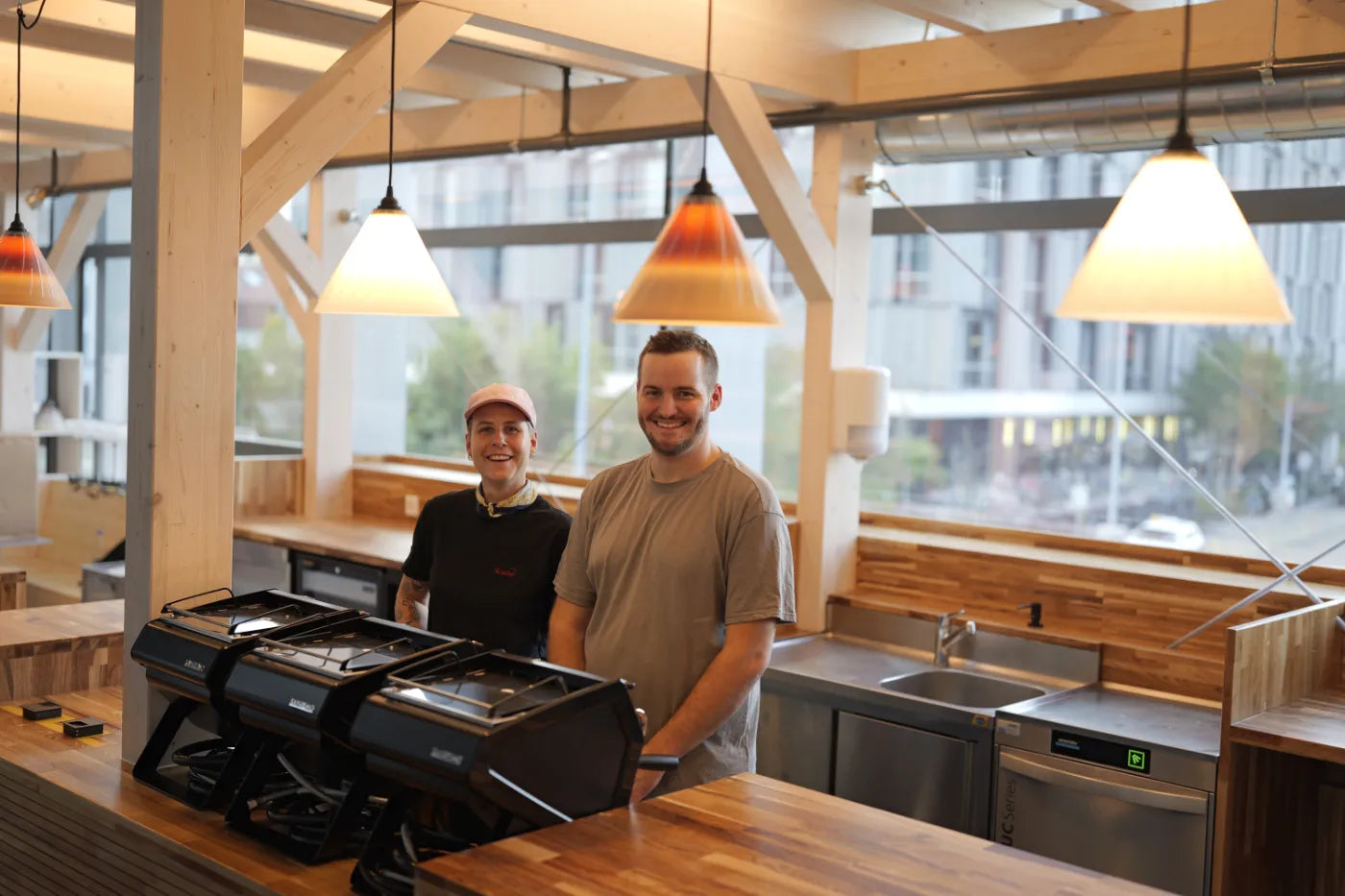
- Kaffeemacher, Basel: The two-story cafe sits inside the Swiss Federal Railways station. Its station work goes beyond takeaway service because Kaffeemacher also offers specialty coffee courses there.
- Roast Coffee, Copenhagen: Roast Coffee operates directly beside Vesterport Station in a compact, kiosk-like structure that previously housed a 7-Eleven.
- Rosslyn Coffee, London: Rosslyn Coffee opened its ninth cafe in London a few weeks before the reported trend, adding another established specialty operator to the transport-adjacent map.
The Basel example pushes the format upward rather than smaller. A two-story cafe inside a main railway station is not the same physical model as Mops at Kunsthaus, but it shares the transit condition: high movement, short windows of attention, and coffee prepared inside the infrastructure people already use. The courses add another layer. Kaffeemacher serves cups at the station and teaches specialty coffee there.
Copenhagen gives the most literal replacement image. Roast Coffee operates beside Vesterport Station in a compact structure that used to house a 7-Eleven. The broad convenience model gives way to a focused coffee operator in a kiosk-like space. That single site tracks the wider change in miniature: less general retail, more specific coffee service, still fitted to station movement.
London’s Rosslyn Coffee enters the story through scale. The company opened its ninth cafe a few weeks before the trend was reported. The detail places an established specialty coffee operator inside the same broader movement of compact, high-volume urban coffee expansion. These counters are run by operators with enough existing structure to add new rooms, not one-off tests of whether commuters will buy better coffee.
The Craft Constraint Inside a Transport Space
A transit cafe cannot behave exactly like a slow bar. Mops names flat whites, specialty coffee, matcha lattes, and takeaway drinks. Miró names batch brews and cappuccinos. Kaffeemacher pairs station coffee service with specialty coffee courses. Each example narrows the offer around products that can operate in a transport setting.
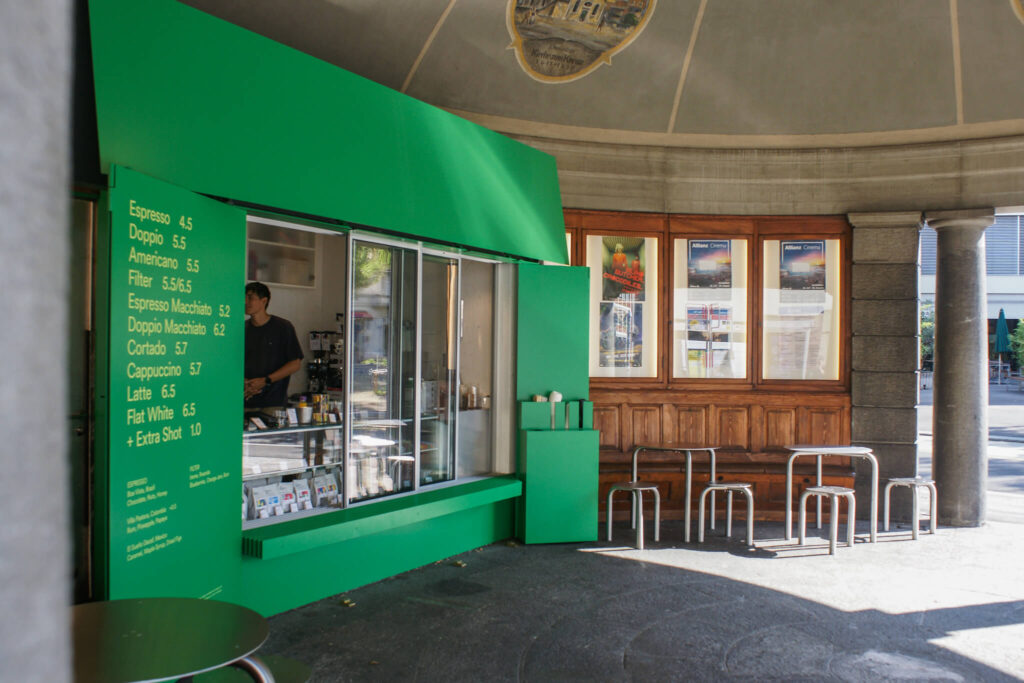
Batch brew is the clearest format named at Kreuzplatz because it suits repeated service without asking every order to begin at the grinder. Cappuccino and flat white keep espresso on the counter. Matcha lattes widen the non-coffee drink set without turning the site back into a broad convenience store. None of that requires a full menu recap. The product shape is focused drinks, short waiting times, small rooms, high customer volume.
Traditional kiosks and convenience stores work from breadth. Specialty coffee operators work from a narrower bar. That shift asks the operator to standardize workflow enough to serve quickly, while keeping product quality central enough to win the tender or justify the site. The public agency’s language in Zurich made that clear. Operators had to meet “to go, specialty coffee, snacks” and show added value.
The Verdict: Kiosks Will Change
The familiar kiosk still belongs in transport life where people need broad convenience, last-minute items, snacks, or printed matter. The supported conclusion is narrower and more durable: traditional kiosk spaces are likely to be complemented or partly replaced by specialty coffee concepts, especially where operators and transport agencies see demand for high-quality takeaway products.
Zurich makes that conclusion concrete because VBZ changed the leasing path. The agency put expiring leases back into competition and selected operators whose concepts answered current demand. Mops at Kunsthaus and Miró at Kreuzplatz are the visible outcomes: flat whites, matcha lattes, batch brews, and cappuccinos served from tram shelters with long civic memory.
Basel, Copenhagen, and London show the pattern spreading through different kinds of urban transport space. Kaffeemacher works inside a Swiss Federal Railways station and teaches coffee there. Roast Coffee occupies a kiosk-like former 7-Eleven beside Vesterport Station. Rosslyn Coffee has added a ninth London cafe. The shared fact is not identical architecture. It is the maturity of specialty coffee operators moving into small, fast, high-volume urban sites.
Transit coffee kiosks now sit at the edge of two systems: the coffee bar and the transport network. The next useful signal will not be whether every old kiosk becomes a cafe. It will be which public operators, station landlords, and established coffee companies can make the smallest rooms carry both speed and craft without asking the commute to slow down.