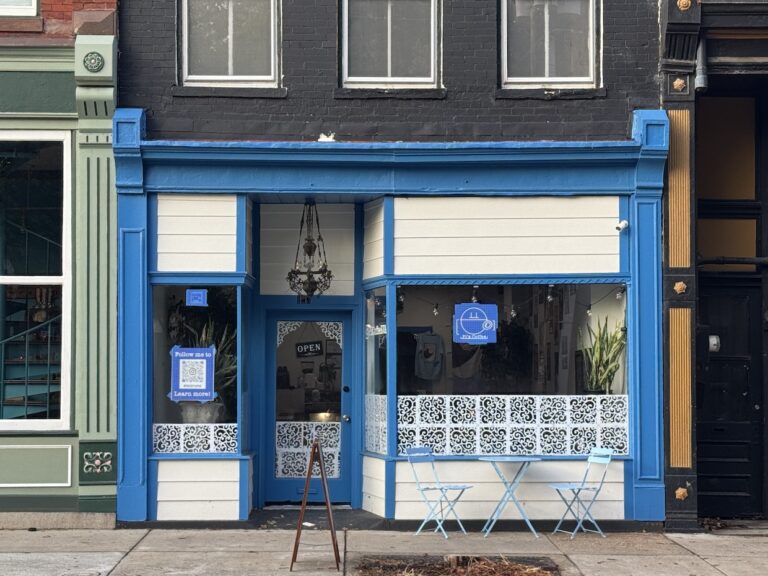
The 5-kilo Coffee-Tech Engineering roaster now sits at the back of Pi's Coffee Richmond, while the bar at 123 E. Main St. pulls Indian-grown coffee through a Nuova Simonelli Appia compact machine. Pi's Coffee opened its first brick-and-mortar cafe on June 24 in Richmond's Monroe Ward Historic District, turning Piyush Jessani's blue-and-white mobile operation into a 1,800-square-foot roastery cafe with India as the source for every coffee on the bar.
The new room carries the same blue-and-white palette as the Pi's Coffee truck across a century-old facade. The move matters because Jessani did not simply add seating and a permanent address. He built a roastery cafe around a narrower promise: specialty coffees grown in India, roasted on site, pulled through a compact espresso setup, and folded into drinks that carry cardamom, rose, almond, and spice without turning the bar into a syrup shelf.
Pi's Coffee Richmond: From Truck to Roastery Cafe
Pi's Coffee Richmond begins with a familiar small-business path, farmers markets, pop-ups, a mobile truck, then a fixed room where regulars can find the same person behind the work. Jessani announced plans for the downtown cafe on March 14, Pi Day, then opened the doors on June 24 at 123 E. Main St.
The permanent address changes the scale of the operation. A truck can build a following and teach a barista how to work under pressure, but a roastery cafe lets the roast, the grinder adjustment, and the menu live under one roof. At Pi's, that means the back of the cafe holds a 5-kilo-capacity Coffee-Tech Engineering shop roaster, while the bar runs on a Nuova Simonelli Appia compact espresso machine paired with a Fiorenzato F64 Evo Pro espresso grinder.
Those machine choices tell you how to read the room. This is not a display roaster tucked behind glass for atmosphere. The 5-kilo roaster gives Jessani a small-batch working rhythm, suited to a cafe that needs to serve daily espresso while still leaving room to adjust for different Indian arabica and robusta lots. The compact Appia keeps the espresso station tight. The Fiorenzato grinder sits where the day gets tuned, dose by dose, as the cafe moves from the first morning rush into the slower middle of the day.
Jessani's own route into coffee did not start with a cafe apprenticeship. He moved to the United States from Bengaluru at age 7 and later studied engineering. During the COVID-19 pandemic, green coffee sent in a care package to his mother from India pushed him into home roasting. That hobby became a business, then a truck, and now a brick-and-mortar roastery in downtown Richmond.
Why Indian Specialty Coffee Deserves Attention Now
Pi's Coffee does something many origin-focused cafes avoid: it narrows the entire coffee program to one country. All brews at Pi's Coffee are based on specialty coffees grown in India, with green arabica and robusta coffees coming primarily through South India Coffee Company. Jessani roasts those coffees himself at the back of the cafe.

The constraint is the point. Instead of treating India as a single guest bag on a retail shelf, Pi's Coffee Richmond makes the country the operating principle. Espresso, South Indian-style filter coffee brews, and flavored specials all begin from that same sourcing frame. The cafe asks customers to stay with India long enough to notice range, not just origin naming.
Jessani has been direct about the choice: "I wanted my cafe to feature coffee only from India, cutting out a niche for my business," said Piyush Jessani1.
That sentence carries the cafe's strongest signal. Plenty of shops build menus around a rotating world map. Pi's Coffee starts with Jessani's home connection and then works outward through importers, roast batches, and drinks. The care package origin story matters here because it ties the home-roasting habit to the present bar. Green coffee moved through family first, then through the business.
Jessani's previous work as a bartender also shapes how Pi's treats flavor. His background included wine tasting and mixology, which informed how he thinks about coffee notes and coffee-based drinks. That helps explain why the signature menu does not read like a generic latte list with Indian names added at the end. The flavors are specific: cardamom and rose in one drink, almond and spices in another.
The Roaster at the Back of the Cafe
The 5-kilo Coffee-Tech Engineering roaster gives Pi's Coffee Richmond a visible production spine. Five kilos is a cafe-scale batch size, large enough to supply the bar but small enough to keep the person roasting close to the person tasting. Jessani can roast, pull shots, listen to the bar, and adjust the next batch from the same room.
That proximity matters with a single-country program. If every coffee comes from India, the roast has to do more than declare an origin. It has to separate one lot from another in the cup and give the espresso machine enough structure for milk drinks, shaken drinks, and filter-style brews. The cafe's use of both arabica and robusta broadens that working range without leaving the sourcing frame.
The importer detail sharpens the story. Green arabica and robusta coffees come primarily from South India Coffee Company, so the sourcing is not an anonymous line on a bag. It is part of how Pi's Coffee Richmond organizes its menu and its production. The customer sees the result at the counter, but the working chain runs from Indian-grown green coffee to Jessani's roaster to the Appia at the bar.
At the bar, the Nuova Simonelli Appia compact espresso machine and Fiorenzato F64 Evo Pro grinder form the service pair. The grinder controls the practical drama of the morning: particle size, retention, and the adjustment that keeps espresso from running thin or choking as the room warms. The Appia carries the drinks that need espresso, but Jessani also uses the machine to replicate South Indian-style filter coffee brews.
That last detail is one of the better reasons to visit in person rather than only buying a bag. South Indian filter coffee has its own service memory, usually tied to a different brewer and a different table ritual. Pi's Coffee routes that memory through cafe equipment in Richmond. It is adaptation, not reenactment, and the bar is where you can taste how Jessani handles the translation.
The Menu: Cardamom, Rose, Almond and Spice
Order the Gulab Jamun latte if you want the clearest bridge between the coffee program and the specials menu. The drink is flavored with cardamom and rose, two aromatics with enough definition to stand beside espresso rather than disappear into milk. It is the order that tells you how Pi's Coffee thinks about sweetness, memory, and extraction in one cup.
The shaken Thundai Latte is the second drink to know. It brings almond and spices into a shaken format, which puts texture into the order before you even reach the flavor. Shaken drinks can soften espresso's edges and change how aromatics lift from the cup. Here, the almond and spice profile keeps the Indian thread visible without requiring a pastry case explanation.
Those two drinks also give the cafe its sensory shorthand. Gulab Jamun latte means cardamom and rose over coffee grown in India and roasted in the same room. Thundai Latte means almond, spice, and a shaken build. Neither drink needs a long ingredient list to explain the concept; the named flavors point back to Jessani's specials menu and forward to the espresso station.
The food menu extends that same family line. Pi's serves an Indian menu developed in part with Khushbu, the catering business owned by Jessani's mother, Kajal Kay Jessani. The cafe makes sandwiches including a chicken tikka grilled cheese and Bombay Aloo panini in-house, while Khushbu supplies dishes including chana masala and saag paneer.
That split is useful for the customer. The in-house sandwiches fit the speed of a downtown cafe lunch, while the Khushbu dishes bring Jessani's family food business directly into the room. The cafe is not only a place where Indian coffee appears on the bar. It is a place where Jessani's roasting, his mother's catering, and Richmond's daily coffee traffic share the same address.
If you are planning one food pairing, start with the Bombay Aloo panini alongside the Gulab Jamun latte. The potato sandwich keeps the savory side of the menu in view, and the latte gives you the cardamom and rose note that defines the house specials. If you want a fuller lunch, chana masala or saag paneer will tell you more about the Khushbu side of the cafe.
What to Order at 123 E. Main St.
For a first visit to Pi's Coffee Richmond, order in a sequence rather than treating the menu as a checklist. Start with a straight espresso-based drink if available, because that shows how Jessani is roasting the current Indian coffee for the bar. Then order the Gulab Jamun latte. The first cup gives you the base. The second shows how the cafe builds flavor around it.
If the South Indian-style filter coffee brew is on offer, make that your next order on a slower visit. It is the drink most directly tied to the cafe's full-circle story: Indian-grown coffee, roasted by Jessani in Richmond, then prepared through the espresso machine to echo a South Indian coffee form. Ask what is in the grinder that day and whether the coffee is arabica, robusta, or a blend of the two. That question will get you closer to the work than asking what is most popular.
Food depends on the hour and appetite. For a shorter stop, the chicken tikka grilled cheese or Bombay Aloo panini keeps the visit in cafe territory. For a meal, look to the Khushbu-supplied chana masala or saag paneer. Either way, the point is not to scan the whole menu. Pick the item that shows the family connection and let the coffee do the rest.
Pi's Coffee is located at 123 E. Main St. in Richmond's Monroe Ward Historic District. Check current hours before you go. Treat it as a first stop rather than an after-work backup, especially if you want to talk through the roast, ask about South India Coffee Company, or catch the bar before the lunch menu takes over the counter.
The next thing to watch is how Jessani's importer relationships shape the menu over time. A cafe built only on Indian-grown specialty coffee has to keep proving range through the grinder, the roaster, and the cup, and Pi's Coffee now has a permanent Richmond room where that work can happen in public.