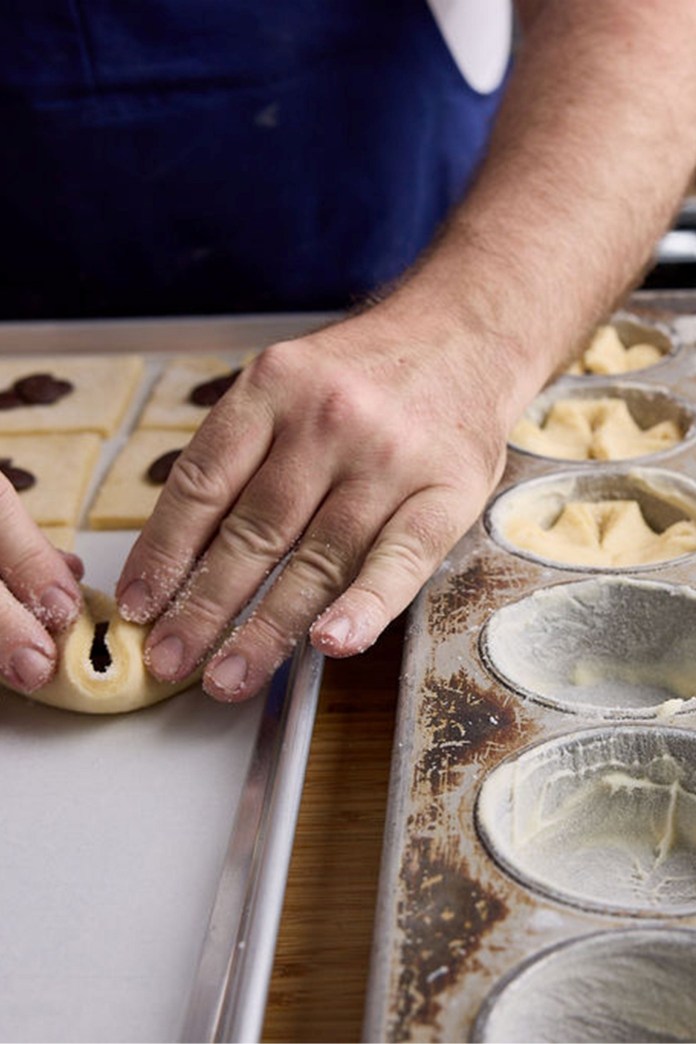
At Starter Bakery, a retail croissant may begin with dough mixed by the bread team in Berkeley, pass to another crew for lamination, travel cold and raw with a driver, land with an afternoon crew at a retail shop, then wait for the morning team to proof, bake and finish it. Brian Wood.
Butter temperature, dough strength, fermentation time, rack temperature and transfer timing all leave evidence in the crust. Wood built Starter Bakery around that evidence. He treats the finished pastry as the result of linked actions across the bakery.
Wood is the Founder, Head Baker and CEO of Starter Bakery, and his work now sits in high-volume wholesale. Approximately 112 people work across seven days a week, nearly 24 hours a day.
The Story of Brian Wood and Starter Bakery
Starter Bakery began with pop-ups and a few wholesale accounts. Its first pop-up took place in November 2010 in partnership with Samin Nosrat and Christopher Lee, formerly of Chez Panisse. The kouign amann drew attention early, and it gave the young bakery a product to organize around. Wood signed a lease in January 2011 and began delivering from the new space in March 2011.
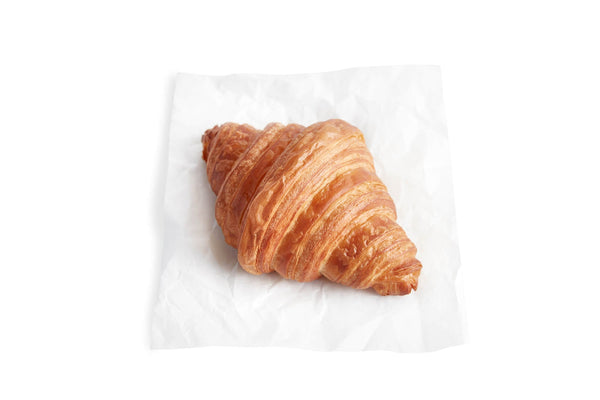
The path from that first pop-up to more than 300 deliveries a day grew through systems. It grew through systems. The bakery’s early facility and modest budget pushed Wood toward practical choices, including a focus on viennoiserie that matched the equipment and the wholesale model. Used equipment and a tight operating frame forced decisions about what the bakery could repeat well.
Wood's work balances craft with rent, wages, utilities, insurance, distribution and wholesale margins. Wood’s approach refuses the fantasy that quality lives apart from operations. A croissant has to eat well. It also has to move through the building, reach a customer, and remain financially viable for the bakery and its accounts.
Starter Bakery’s identity began with the kouign amann. It was the pastry that helped Starter build its identity. In the kouign amann, sugar, lamination and bake all have to land together. The retail croissant moves through the system from mix to lamination to proof to bake.
From Summer-Camp Kitchen to Systems-Minded Pastry Chef
Wood’s first professional kitchen experience came in 1994 at a summer camp in upstate New York, where he had previously worked as a counselor. In the kitchen, he joined a team of four or five producing three meals a day for about 400 campers. Wood got volume before refinement. Food service becomes a logistics problem as soon as the head count climbs.
After graduating with a degree in cultural anthropology, Wood spoke with his college career center and began considering pastry. Within six months, he enrolled in an 18-month pastry certificate program at a community college in Seattle. The move led him to production bakeries where repetition, timing and handoffs define the work.
After the certificate program, Wood joined Grand Central Bakery. He later accepted a night-baking position with William Leaman at Essential Baking Company. The night shift left him alone or nearly alone, responsible for results that would be judged hours later by people who never saw the work. In his off-hours, he learned more about chocolate, viennoiserie and entremets.
Wood then became involved in chocolate production and helped launch Essential Chocolates, which later became Theo Chocolate. That stop added another layer to his ingredient thinking. He became involved in chocolate production there. Selecting chocolate requires attention to cocoa-butter content, sweetness, flavor profile, format and melting characteristics because each variable changes how chocolate behaves inside a pastry and how the finished pastry eats.
Leaman later encouraged Wood to pursue an internship at the San Francisco Baking Institute. There, Wood studied alongside Didier Rosada and Jeff Yankellow. The institute gave him technique and language. Teaching and contributing to the development of a baking book required him to explain systems clearly enough for someone else to repeat them. That ability now sits at the center of Starter Bakery’s operation.
Why Process Became the Craft
Wood’s philosophy centers on process and organization. Wood says process is everything. For Starter Bakery, that line is an operating method for a bakery where one product may pass through several teams before a customer sees it.
Wood puts the stakes plainly: "If we had no system in place, we wouldn’t be able to scale"1.
Process changes the craft problem. A small bakery can rely on the instincts of the person mixing, folding, shaping and baking. A larger bakery has to move those instincts into documented standards, training, tasting, sequence and feedback. The next person has to receive dough in the condition the formula requires.
Wood’s controlled testing reflects that shift. When he evaluates flour or butter, he isolates variables. Two flours can be compared in otherwise identical formulas. Add two different butters and the test expands to four combinations. That structure lets the bakery examine each ingredient and the way those ingredients interact. Pastry is chemistry made edible.
The retail croissant development shows the depth of that process. Wood estimates that the Starter team conducted approximately 40 tests involving flour choice, sugar percentage, butter type and butter percentage. Those tests were a way to decide how a croissant should behave across production, transfer, proofing, baking, finishing and eating.
Blind tasting gives the system a check against preference and hierarchy. The team looks at crust appearance, internal crumb structure, flavor, aftertaste and keeping quality. Those categories keep the conversation grounded. A croissant has to survive the same criteria the next test will face.
The Croissant Problem at 65°F
Wood’s recent quality-control work included blistering on croissants at Starter Bakery’s retail shops. Wood spent time in the lamination room and saw trays of retail product loaded onto a room-temperature rack before transfer. The rack sat at approximately 65°F, and some trays stayed there for roughly 45 minutes.
At approximately 65°F, the rack let the dough keep fermenting for roughly 45 minutes. The trays were not cooling quickly enough. Acidity continued to build in the dough, and that shift contributed to the blistered surface. Wood reinstated the intended procedure of refrigerating each tray as it was completed. The blistering disappeared.
The blistering disappeared.
Wood’s lesson from the case is that small process changes ripple through the finished product. Wood addressed the blistering without changing the croissant. He traced the route, identified a broken handoff and put the intended refrigeration step back in place. The fix protected the product by restoring the system.
Wholesale pastry becomes difficult to fake. A bakery operating nearly around the clock cannot depend on memory alone. Procedures have to hold through shift changes, deliveries, retail receiving, proofing windows and morning bakes. Every person in the chain needs to know what condition the pastry should be in when it arrives and what action comes next.
Inside the Tests Behind a Starter Croissant
Wood treats each formula as a set of decisions that can be isolated, tested and tasted. Flour choice can change dough strength. Butter type and butter percentage can change lamination behavior. Sugar percentage can change fermentation, browning and the way a croissant carries flavor after the first bite.
Those variables multiply quickly. Mixer style, mixer size, friction, water temperature, mixing time, dough temperature, fermentation, lamination, proofing, pan choice and baking conditions all influence the final pastry. In a one-room bakery, a baker may adjust by feel. In a wholesale operation with multiple teams, Wood has to turn feel into a process that another person can read in the dough.
The same thinking applies to the kouign amann, the product tied to Starter Bakery’s early identity. Sugar has to enter the layers without liquefying too soon, tearing the lamination or making a mess on the sheeter. The dough does not need the same strength as croissant dough. That difference matters because overmixing changes how the dough handles before it ever reaches the bake.
For the customer, these details show up as texture, structure and keeping quality. For the team, they become checkpoints. A crust has an appearance. A crumb has an internal structure. A finished pastry leaves an aftertaste. A product either holds after baking or it does not. Wood’s testing system gives the bakery a vocabulary for catching those differences before scale hides them.
Scaling Without Losing the Baker’s Hand
Wood continued working croissant shifts himself for several years, sometimes alone and sometimes with a small team. That bench time gives a founder authority because the procedures come from lived repetition. Eventually, Starter Bakery required a different role from him. Today, Wood is rarely part of daily production, and that distance makes the system more important.
The phrase “losing the baker’s hand” often comes up when craft food businesses grow. For Starter Bakery, the hand has to become a set of shared expectations. If those decisions remain trapped in one person’s instinct, the bakery cannot make more than 300 daily deliveries with consistency.
That makes the human work more visible. Mixing has to follow the target. Lamination has to keep the butter layer intact. The trays have to move cold. The team has to catch a rack that interrupts the intended cooling path. Blind tasting has to hold even when the result disrupts a favorite idea.
Starter Bakery’s staffing and schedule put leadership under pressure. Approximately 112 people working seven days a week, nearly 24 hours a day, need more than a good formula. They need handoffs that do not depend on who happens to be in the room. They need shared language for quality. The staff need the authority to follow the system and the feedback to adjust it when the pastry proves something has shifted.
That is the useful tension in Wood’s career. His training includes Grand Central Bakery, Essential Baking Company, Essential Chocolates, Theo Chocolate and the San Francisco Baking Institute. His current work asks him to translate that background into a bakery large enough that he cannot personally touch every batch. The craft moves from touch to transfer.
What to Order, and What to Watch Next
It is the pastry tied to the bakery’s first public identity, the one that helped carry the early pop-up response into a wholesale business. The kouign amann combines sugar, butter and layered dough in one bite.
It carries the testing program, the approximately 40 development trials, the flour and butter comparisons, the sugar and butter percentage decisions, and the handoff system that moves one pastry through multiple teams. A good croissant can taste effortless.
Wood’s process protects the qualities a baker wants to preserve. The oven does not care whether a bakery uses romantic language. Dough responds to temperature, mixing, fermentation, lamination and time. Starter Bakery’s growth shows what happens when a pastry chef gives those variables names, tests and owners.
Starter Bakery continues to balance volume with specificity. More than 300 deliveries a day create pressure on every handoff. Wood’s work suggests that the answer will come from the same place as the croissant fix: a tray, a rack, a temperature, a delay, and the decision to make the system honest enough to catch it.