Green coffee now comes through the front garage door of a former Northeast Portland flower shop by forklift, then lands beside Pastime Coffee's own production line. The Pastime Coffee Portland roastery gives founder Justin Dedini and co-owner Erica Schwager a 1,000-square-foot room after launching the company at Buckman Coffee Factory in 2024, and it arrives in the same stretch as Pastime's 2025 acquisition of Thatcher's Coffee in Vancouver, Washington.
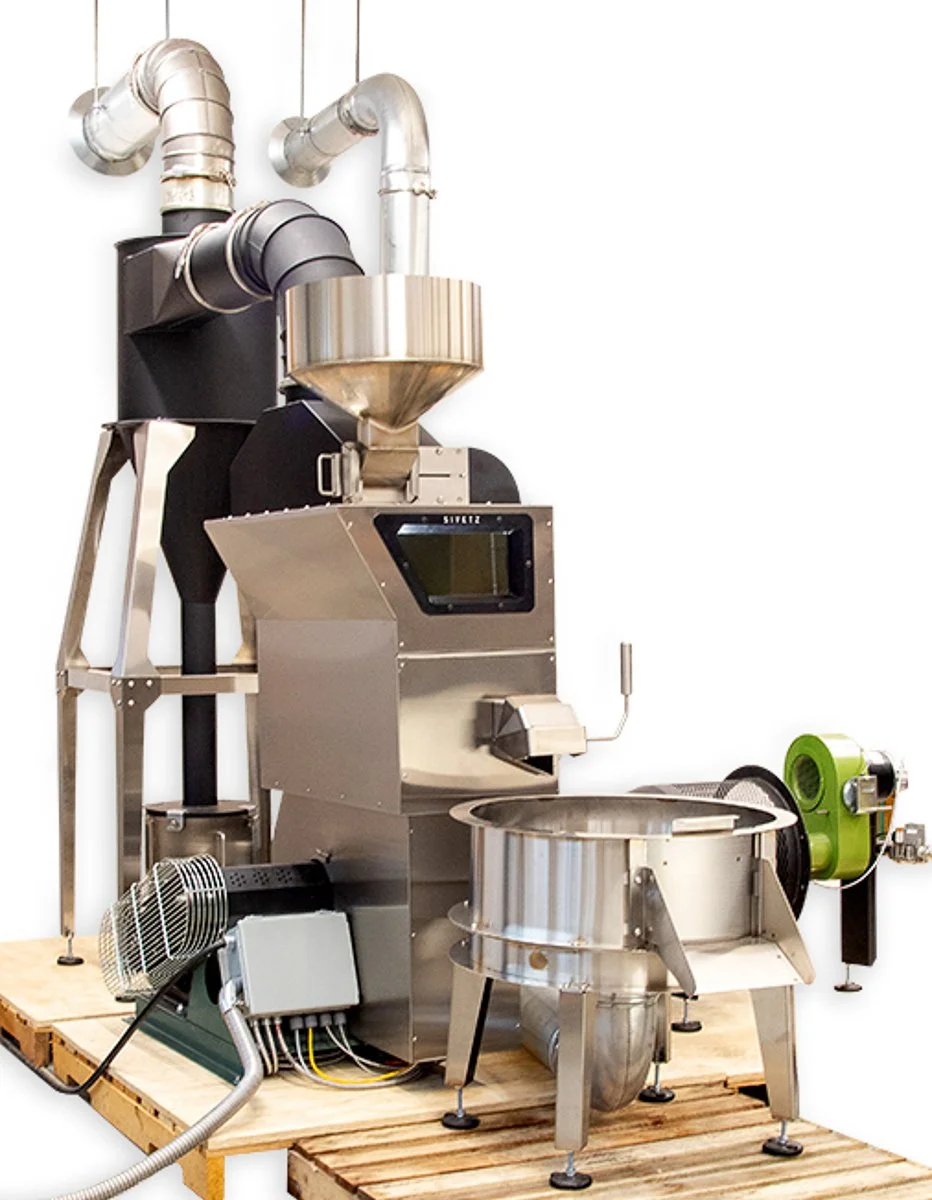
The move gives Pastime its first production space of its own. It also gives the Portland roaster a retail counter across the Columbia River through Thatcher's Coffee, whose ownership transition coincided with the cafe's 15th anniversary. For a roaster still young by brand age, the infrastructure now looks older than the founding date: a 15-kilogram-capacity Sivetz SRM-15 fluid-bed roaster, a VortX EcoFilter, a forklift parking spot in the paved backyard, and two operators with nearly 40 years in specialty coffee between them (Drinktrade).
Why the Pastime Coffee roastery in Portland changes the work
Dedini has been in coffee since 2004, beginning with a high school job at an espresso and barbecue stand. Before Pastime, he roasted for Heart Coffee and Roseline Coffee in Portland. Schwager, a former Roseline colleague, worked in management and training for Gimme! Coffee in New York before roles at Nossa Familia, Roseline, and Coava Coffee in Portland. At Pastime, she contributes to production roasting and wholesale sales while leading operations at Thatcher's Coffee (Drinktrade).
The new room matters because it changes the daily mechanics. Shared roasting works when a brand needs access, scheduling, and community before it needs its own exhaust system and green coffee storage. A production space of its own asks different questions: where the forklift turns, how far green coffee travels, where roasted coffee cools, how many steps separate the roaster from bagging, and how predictable the roast week can become for wholesale accounts.
Dedini chose the footprint with production motion in mind. "Everyone likes to overestimate how much space they need, because what if you need more? And it's really at the sacrifice of day-to-day efficiency in production, so we did the opposite," said Justin Dedini1.
Pastime did not move into a room built for spectacle. It moved into a former flower shop sized around roaster flow, exhaust treatment, back stock, a garage door, and a paved yard. The Pastime Coffee Portland roastery is a production answer first, and the scarcity is plain: this is the company's first room of its own after starting inside a shared roasting facility.
From Buckman Coffee Factory to a room of their own
Pastime began at Buckman Coffee Factory in 2024, a return of sorts for Dedini. He had been an early client there while roasting for a now-closed cafe he managed in Northwest Portland. Buckman Coffee Factory has functioned as a practical bridge where a roaster can build accounts, test buying decisions, and find a roast cadence before signing onto the cost of equipment and a room.
Pastime's exit from that shared model lands differently because of Dedini's roasting lineage. Heart Coffee and Roseline Coffee both sit inside Portland's specialty coffee memory for drinkers who follow roast style as closely as cafe openings. Schwager's path adds a training and operations layer, from Gimme! Coffee to Nossa Familia, Roseline, and Coava. Their Pastime roles now meet in the same production cycle: Dedini's roasting background, Schwager's training and administrative history, and a wholesale base that needs repeatability.
The brand's home brewing details give a small window into how they think about daily coffee outside production scale. Justin uses the Aiden brewer by Fellow. Erica uses a Ratio 6. Those choices sit close to the customer Pastime is courting: the person ordering whole beans, reading roast dates, and waiting long enough after roasting for the cup to settle.
Pastime recommends giving coffee time to rest before espresso or morning batch brew. Chasingbourbon.
The 15-kilogram Sivetz, the VortX, and the forklift spot
The center of the Northeast Portland facility is a 15-kilogram-capacity Sivetz SRM-15 fluid-bed roaster. Fluid-bed roasting uses hot air as the primary roasting medium, and in Pastime's room that machine is paired with a VortX EcoFilter. The VortX uses atomized water to treat roaster exhaust instead of a gas-powered afterburner.
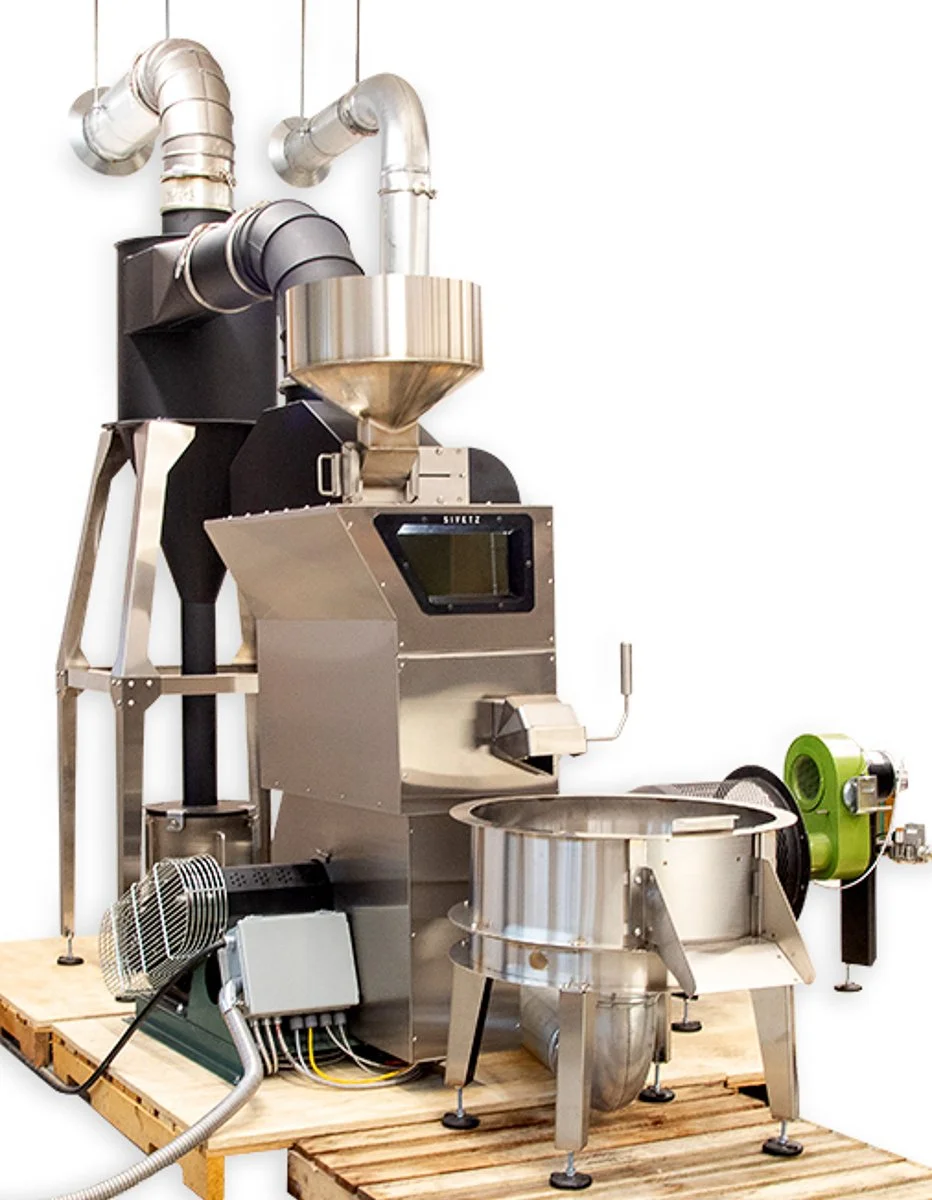
Those equipment choices shape the building. The roaster requires ducting, exhaust treatment, green coffee intake, cooling, chaff handling, and cleaning routines. In Pastime's case, a forklift carries green coffee through a garage door at the front of the former flower shop and parks in the paved backyard. The room was planned around bags and pallets.
Pastime also gains a different production rhythm than a tiny sample-forward setup. It can roast wholesale batches while staying within a small room. The space supports back stock and day-to-day movement without stretching the team across a warehouse-sized floor. Dedini chose the smallest workable space with enough room for production.
Pastime sources through importers including Shared Source, Atlantic Specialty Coffee, and ICT Coffee. Dedini's stated sourcing aim is continuity: buying larger amounts from single producers or communities where possible, and working toward buying entire producer harvests to support price stability and repeat purchasing. That approach raises the stakes inside the new room. If Pastime wants to be a consistent buyer, it also has to be a consistent roaster for the wholesale and retail accounts receiving the coffee.
Thatcher's Coffee gives Pastime a Vancouver counter
The roastery opening arrived alongside another move: Pastime acquired Thatcher's Coffee in Vancouver, Washington in 2025. The cafe sits across the Columbia River from Portland, and the ownership transition coincided with Thatcher's 15th anniversary. Pastime has kept the cafe largely unchanged so far.
That restraint matters. Thatcher's Coffee gives Pastime a controlled place to serve its coffee, and the cafe is a 15-year-old neighborhood counter with established customer habits. Thatcher's already had its own customer base before the Pastime handoff. Its former owner had known Dedini and Schwager through Roseline, where Thatcher's had been a wholesale customer.
Schwager's role connects the cafe and roastery. She leads operations at Thatcher's while contributing to Pastime production roasting and wholesale sales. That gives the company a direct feedback loop: production decisions in Northeast Portland, retail service in Vancouver, and wholesale conversations running through the same ownership team.
Pastime's production work now happens in Northeast Portland. Thatcher's remains the Vancouver counter with its established identity. If the roastery is where the roast day gets solved, Thatcher's is where Pastime can observe daily service without building a new cafe from scratch. The insider access is in that split: one side shows production, the other shows how the coffee behaves across a working bar with an existing crowd.
How to buy, rest, and watch the next step
Pastime direct ships orders from Portland, Oregon. The roaster currently roasts all orders on Tuesday and Thursday, and orders placed after 4:30am PST on either roast day ship on the following roast day. Orders placed before the Tuesday or Thursday cutoff ship from the new production cycle, and Pastime recommends 7 days of rest before brewing (Chasingbourbon).
Pastime sells whole-bean coffee on that roast schedule. The new Northeast Portland room exists to make production steadier. Brew it on the kind of home setup Pastime's owners actually use, an Aiden brewer by Fellow in Justin's case, a Ratio 6 in Erica's.
There may be more public-facing access at the roastery in time. Pastime plans to offer cuppings by appointment and is considering a limited-hours pop-up coffee cart in the open garage bay at the front of the building.
The Pastime Coffee Portland roastery gives Dedini and Schwager their own production floor, while Thatcher's gives them a working counter with 15 years of local habit behind it.