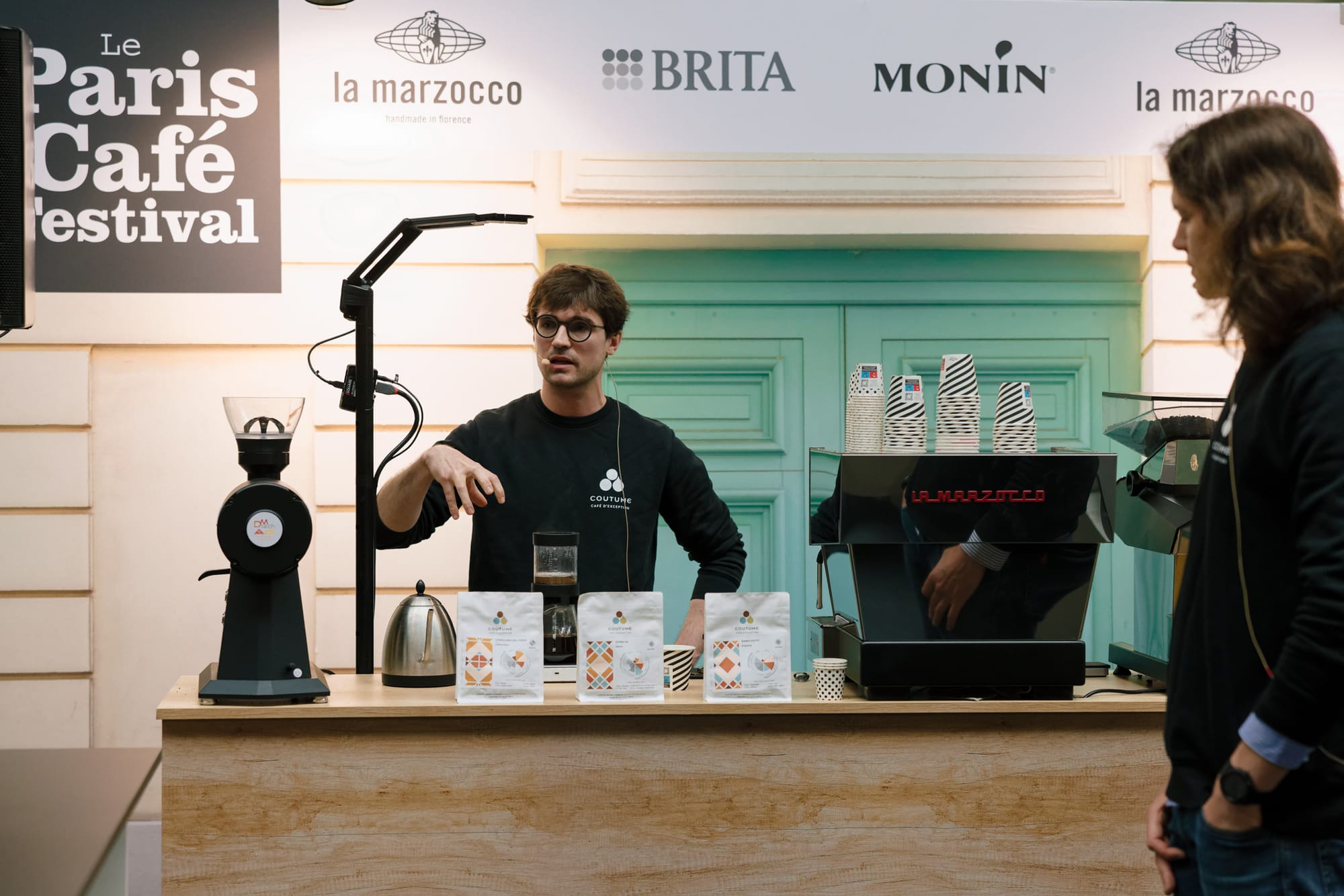
The route to the hall started with a walk through Parc Floral de Paris, on the eastern edge near the Bois de Vincennes, before anyone reached a stand, a cupping table, or a competition machine. Paris Coffee Show 2026 took place 12 to 14 September 2026 at Parc Floral de Paris, 26 route de la Pyramide, 75012 Paris, and its seventh edition made service the working question for French specialty coffee. Not whether the cup could be good. Whether the counter could hold.
The frame was practical from the door. Admission was €18 per day in advance and €20 on-site. Saturday 12 September and Sunday 13 September ran 10:00 to 19:00; Monday 14 September ran 10:00 to 18:30. Collectif Café, France’s main professional coffee federation, founded in 1959, organized the event. The program brought 21 conferences with more than 80 speakers, 18 workshops, 10 cupping sessions, and five recognized competitions to one address in the 12th arrondissement.
The official theme, “Drink great coffee like great wine” (“Boire un grand café comme un grand vin”), still put terroir, tasting, and expertise in the room. But the clearer lesson sat closer to the till. France’s specialty coffee operators have spent years learning how to talk about origin, roast, processing, and cup score. At the Paris Coffee Show 2026, the harder question was what happens after a customer walks in hungry, under-caffeinated, unsure what to order, and with 12 minutes before the next Métro.
Why Paris Coffee Show 2026 put service before beans
A coffee show usually lets the bean take the first bow. Producers name farms. Importers open sample bags. Roasters discuss development time, solubility, and the place where a filter roast stops being transparent and starts tasting thin. Those conversations still mattered at Parc Floral. Ten cupping sessions gave professionals and enthusiasts a way to taste side by side, with spoons, forms, and quiet recalibration between bowls. Five national competitions put technical skill under pressure, including French titles for roasting, cup tasters, coffee technicians, best coffee shop, and best espresso.
Yet the event’s center of gravity had moved. The issue was no longer only whether a shop could buy better green coffee or serve a more articulate espresso. Many can. Access to quality has widened. Equipment has improved. Training language has spread. In a crowded city, the counter becomes the test: how quickly the barista reads the guest, how clearly the menu speaks, how the queue moves, how much explanation helps before it starts to slow the room.
That sentence lands because it names the handoff now happening in specialty coffee. Precision has not disappeared. It has moved into repeatable systems: grinders held to recipe, machines built for stability, technicians trained to keep water, pressure, and extraction within range. A barista still needs to taste, adjust, and notice. But when the equipment carries more of the technical load, the human work becomes more visible. Greeting, listening, translating. The soft skills are not soft when the rent is due.
For the customer, the difference shows up before the cup reaches the saucer. A guest who does not know the producer, processing method, or roast curve can still feel whether the barista has time for them. A commuter can tell whether the espresso bar has designed its line for speed. A traveler can tell whether the menu invites a question or punishes one. In France, where café culture already has its own codes of pace, seating, and daily ritual, specialty coffee has to learn hospitality in the local grammar, not imported script.
The numbers behind France’s specialty coffee crowding
The Paris Coffee Show 2026 expected more than 5,000 professionals and enthusiasts over three days. That scale matters because the event is no longer just a gathering for roasters and baristas who already know one another by first name. It sits inside a national market that has multiplied its meetings, competitions, regional editions, and shop openings. The Paris show has already given rise to regional editions in Tours, Bordeaux, and Lyon, while independent events have added more dates to the calendar.
people on their lunch break make the effort to come to us after their meal elsewhere when they could have had their coffee there he says we have to reward them with speed and1
Thomas Philips, Motors Coffee
Jubert has described an explosion of coffee events in France over the past few years, with many professionals in Paris feeling the calendar now exceeds the size of the community. That observation explains the mixed signal around the 2026 edition: a strong program on paper, but attendance that felt lower than in previous years. The reasons named around the show were market saturation and pressure on consumer spending. In other words, the people are interested, but time and cash are tighter.
The Paris retail backdrop sharpens the point. The market analysis around the event said the city is seeing up to 10 new coffee shop openings per week. Even if every one of those shops buys competent coffee, keeps milk cold, and knows how to steam a flat white, the customer cannot visit all of them. Origin stories alone cannot carry that many counters. Neither can a wall of retail bags or a tasting note card that reads like a wine back label.
That is where service becomes a survival tool. A shop that opens on a busy street has to decide what it is built to do. Is it a standing espresso stop, fast at 8:40 and 13:20? Is it a slower filter counter where the brew method earns a conversation? Is it a bakery-led room where the first tray out of the oven sets the morning rhythm and coffee must match the pastry schedule? The wrong service model can make good coffee feel confused.
For operators, the Paris Coffee Show 2026 offered a useful warning. Growth can make a market look healthy while thinning attention across too many rooms. Events multiply. Shops multiply. Supplier meetings multiply. Customers still make one choice at breakfast. They choose the place that understands the moment they are in.
Six zones, five competitions, and a wider definition of the counter
The show ran across six themed zones covering roasters, producers, baristas, importers, and equipment makers. That spread reflects how a coffee shop now sells more than brewed coffee. It sells pace, choice, ergonomics, training, and the confidence that the second cup of the day will not undo the first. Equipment makers sit in that conversation because workflow shapes hospitality. Importers sit in it because a coffee’s story has to survive translation at the bar. Roasters sit in it because a profile must work in service, not just on the cupping table.
The program also pointed toward a wider beverage shelf. The show’s sector framing included alternative beverages, tea, bean-to-bar, food offerings for coffee shops, and equipment innovations as trends in the French market. This does not mean every shop needs a longer menu. It means the modern coffee counter is under pressure to answer more needs during the day. A morning espresso guest, an afternoon tea drinker, a parent buying chocolate, and a laptop worker looking for something beyond a third coffee may all cross the same threshold.
That pressure can help or harm a shop. Add too much and the bar loses its spine. Add the right thing and the service becomes more useful without slowing the team. A pastry program, for example, changes coffee demand by hour. A tea offer changes how staff explain extraction, temperature, and steeping without leaning on espresso language. Bean-to-bar chocolate gives a shop another craft object to sell, but only if the team can explain why it belongs next to the coffee rather than beside the till as decoration.
The five recognized competitions gave this service turn a competitive shape. Roasting still asks for judgment before the customer arrives. Cup tasters still prove that sensory skill matters. Coffee technicians remind the room that a broken machine can ruin a morning faster than a bland tasting note. Best espresso narrows the craft to a short cup under pressure. Best coffee shop brings the pieces together. That last category matters in the current French market because the shop, not the single beverage, is where the industry now has to prove itself.
For a visitor, the most useful way to read a competition like this is not to ask who has the most advanced coffee. Ask which station looks calm under load. Watch who wipes the counter before the judges ask. Watch who explains without lecturing. Watch who keeps the grinder area clean when the timer is running. Service leaves tracks.
From origin storytelling to hospitality systems
The phrase “Drink great coffee like great wine” gives coffee a familiar French comparison. Wine has terroir, cellar work, service temperature, glassware, vocabulary, and ritual. Coffee can borrow some of that structure, but it cannot borrow the whole table. Most coffee is served quickly, often before work, frequently to people who did not set aside an hour to taste. A café guest may care about origin after trust has been built. First, they need to be served.
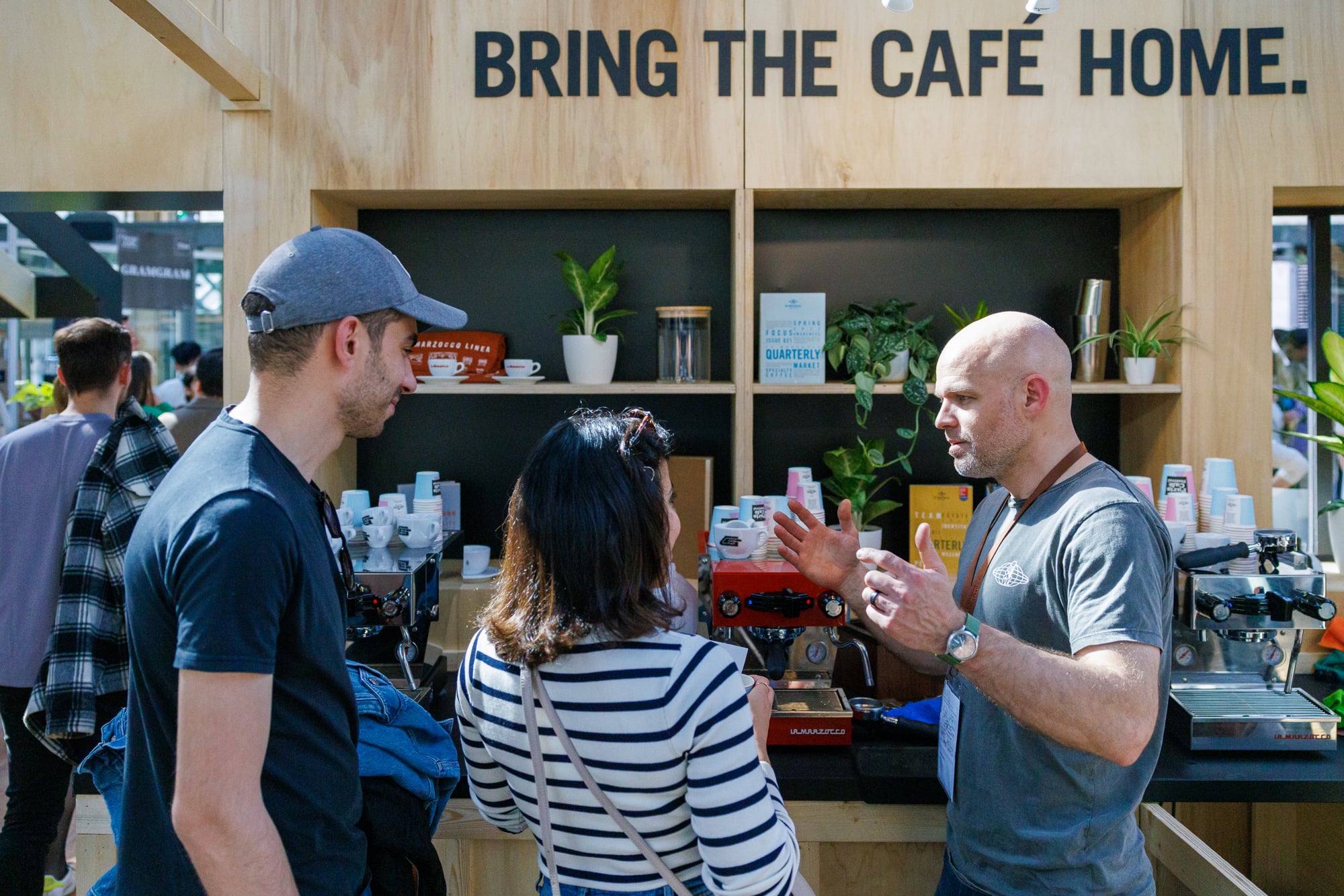
This is where France’s specialty coffee sector now seems to be changing. The first wave of differentiation came through product: single origins, lighter roasting, traceable sourcing, cleaner extraction, a departure from the burnt or anonymous cup. That work still counts. But once enough shops can serve a balanced espresso and a well-extracted filter, product quality becomes the floor rather than the story.
Hospitality systems are less visible than coffee bags, but they decide the room. A service-led shop trains staff to ask useful questions: milk or black, quick or sit-down, familiar or curious, pastry first or coffee first. It writes menus that reduce friction. It sets a brew bar pace that does not trap the whole queue behind one elaborate order. It gives the barista permission to guide a guest toward the drink they will enjoy, not the drink that makes the shop look clever.
For specialty coffee obsessives, this can sound like a concession. It is not. Service can protect craft from becoming private language. A washed coffee on filter may have a precise profile, but the guest still needs a reason to choose it at 9:05. A natural espresso may be expressive, but the staff member has to know whether the customer wants acidity, sweetness, milk texture, or speed. Good hospitality does not flatten coffee. It gets the right cup to the right person.
The same applies to bakeries that have added specialty coffee or coffee shops that have added food. A laminated pastry program lives by timing: first bake, second bake, sell-out hour, tray temperature, butter aroma, crumb texture. Coffee service has to respect that schedule. If the best croissants sell between opening and mid-morning, the espresso bar cannot be designed as if everyone has six minutes for a pour-over conversation. A counter that understands its own rush can make craft feel generous instead of fussy.
What European coffee operators can take from Paris
The lesson from Paris does not stay in Paris. London, Berlin, Copenhagen, Amsterdam, Madrid, and other European coffee cities have all lived through versions of the same curve: first discovery, then specialization, then saturation, then the search for a sharper reason to return. The French case has its own café history, but the operator problem is familiar. When the guest can find good beans in several neighborhoods, the visit has to work better.
For owners, that means training cannot stop at dial-in sheets. Recipes matter. A 1:2 espresso ratio, a 25 to 30 second target, or a filter recipe built around a chosen dose and yield can steady a bar. But a recipe does not greet a customer. It does not explain why one espresso costs more than another. It does not notice that a regular has five minutes today instead of 20. Service training needs the same repetition as technical training.
That also changes how a shop buys equipment. The right machine is not only the one that holds temperature. It is the one that fits the bar team, the queue, the menu, and the labor model. The right grinder is not only the one with a clean particle distribution. It is the one staff can adjust, clean, and trust at opening. The right batch brewer may serve hospitality better than a theatrical manual bar during a rush. Precision belongs in the cup, but the guest experiences precision as ease.
The Paris Coffee Show 2026 put that equation in front of more than 5,000 expected attendees, across conferences, workshops, cuppings, competitions, and the floor conversations that happen between scheduled events. The trade value was not only in tasting new coffees. It was in watching a market admit that access to better beans no longer settles the question. The question is whether the shop can earn the next visit.
For travelers, the practical takeaway is simple. In Paris, do not judge the new coffee wave by origin boards alone. Order espresso first if you want to test the bar. Ask one question about the coffee and watch whether the answer helps you choose. If there is food, ask when the first bake lands or when the thing you came for usually sells out. The best counters will answer with time, not performance.
The next cup after Parc Floral
The seventh edition closed on 14 September, but the work it named is still open at the counter. Collectif Café now has a Paris show with regional echoes in Tours, Bordeaux, and Lyon, a national competition structure, and a French market where the number of openings has made sameness easier to spot.
The next useful coffee event in France will not be the one with the longest list of origins.
It will be the one where a roaster, a technician, a barista, and an owner can talk honestly about what happens when the room fills, the grinder needs adjustment, the pastry case is half empty, and the next customer has already decided how much patience they brought with them.
Frequently Asked Questions
When does Paris Coffee Show 2026 take place?
Paris Coffee Show 2026 runs from 12 to 14 September 2026 at Parc Floral de Paris. Saturday and Sunday hours are 10:00 to 19:00, while Monday closes earlier at 18:30.
How much does admission to Paris Coffee Show 2026 cost?
Admission costs €18 per day when purchased in advance and €20 on-site. The event takes place at Parc Floral de Paris in the 12th arrondissement.
What is the official theme of Paris Coffee Show 2026?
The official theme is 'Drink great coffee like great wine' ('Boire un grand café comme un grand vin'), emphasizing terroir, tasting expertise, and the parallels between specialty coffee and wine culture. However, the event's practical focus centered more on service and hospitality.
What competitions are held at Paris Coffee Show 2026?
The event hosts five national competitions including French titles for roasting, cup tasters, coffee technicians, best coffee shop, and best espresso. These competitions put technical skill under competitive pressure alongside the educational programming.
Who organizes the Paris Coffee Show?
Collectif Café, France's main professional coffee federation founded in 1959, organizes the event. The 2026 edition is the seventh year of the show.