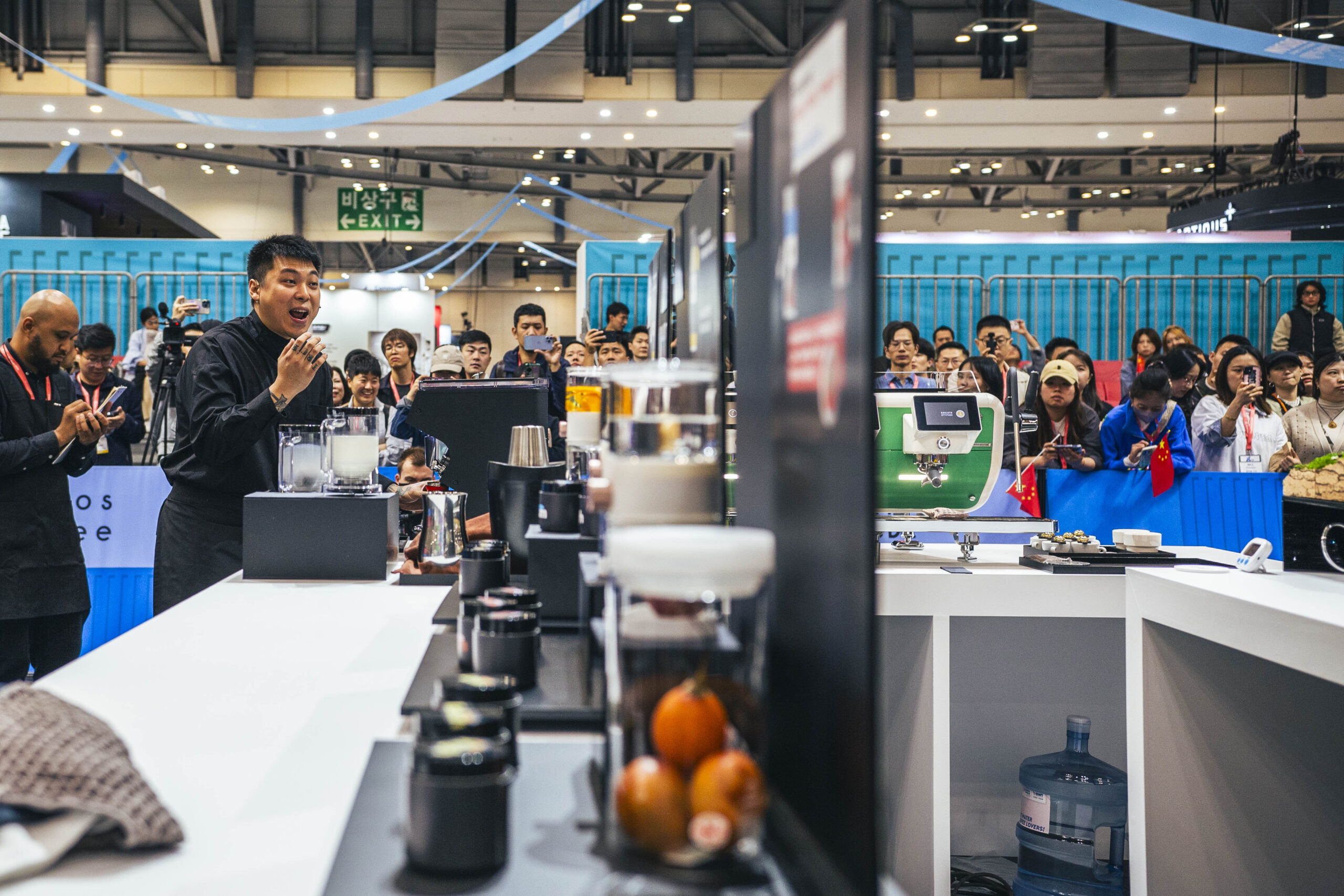
The shots in Panama City ran at 20g in and 50g out, with Bibe Coffee showing real-time stats while Pan Wei served a Panama Gesha to the judges. Pan Wei of Parking Coffee in China won the 2026 World Barista Championship, China’s first title at the event, in a field of 49 national Barista Champions. The win came on his second world-level appearance, after a 27th-place finish at the 2024 World Barista Championship and a 2021 China Barista Championship title (Sprudge).
Pan Wei built his routine around two Geshas at the 2026 World Barista Championship. Pan Wei has worked in coffee for 12 years and has competed for the same stretch of time. He built it around two Geshas, one from Finca El Pergamino in Chiriquí, Panama, the other a mosto-fermented Gesha from Finca Las Flores in Huila, Colombia. (Wcc).
The result gives China the title it had been chasing through a long run of near-misses. Jeremy Zhang had been a Chinese fixture in WBC Finals years ago. Simon SunLei placed second in 2025.
Pan Wei Wins the World Barista Championship for China
The 2026 World Barista Championship ended with Pan Wei as champion, Shing Win of Malaysia as runner-up, and Frederick Ruben of the United Arab Emirates in third. The event took place in Panama City. Finca El Pergamino sat at the center of his espresso course. Finca Las Flores carried the milk course. Both reappeared in the signature beverage (Sprudge).
For a competition built on repeatability under pressure, Pan Wei’s background matters. He was already a China Barista Champion in 2021. His 2024 WBC result, 27th place, put a number on the distance between national success and a finals-level world routine. Two years later, he returned as China’s representative and won.
Pan Wei won China’s first WBC title in Panama City. A decade earlier, Jeremy Zhang’s finals presence made a Chinese WBC title feel possible. Then came years when Chinese competitors did not get past the semifinals. Simon SunLei’s second-place finish in 2025 put China back at the edge of the title. Pan Wei crossed it in Panama City.
China’s first WBC title after years in the circuit and Pan Wei’s return after a world-stage miss. Competitors stayed in the circuit long enough for routines to sharpen, for national-stage experience to translate, and for baristas like Pan Wei to return after a world-stage miss with a tighter plan. Twelve years behind the bar and twelve years competing gave him a long memory for what judges hear, see, and taste.
Two Geshas, One from Chiriquí and One from Huila
Pan Wei’s coffee selection drew a clean line through the routine. The recipe was 20g in and 50g out. The shots were presented with notes of orange, peach, and elderflower florality, followed by a green tea finish, medium weight, and juicy texture.
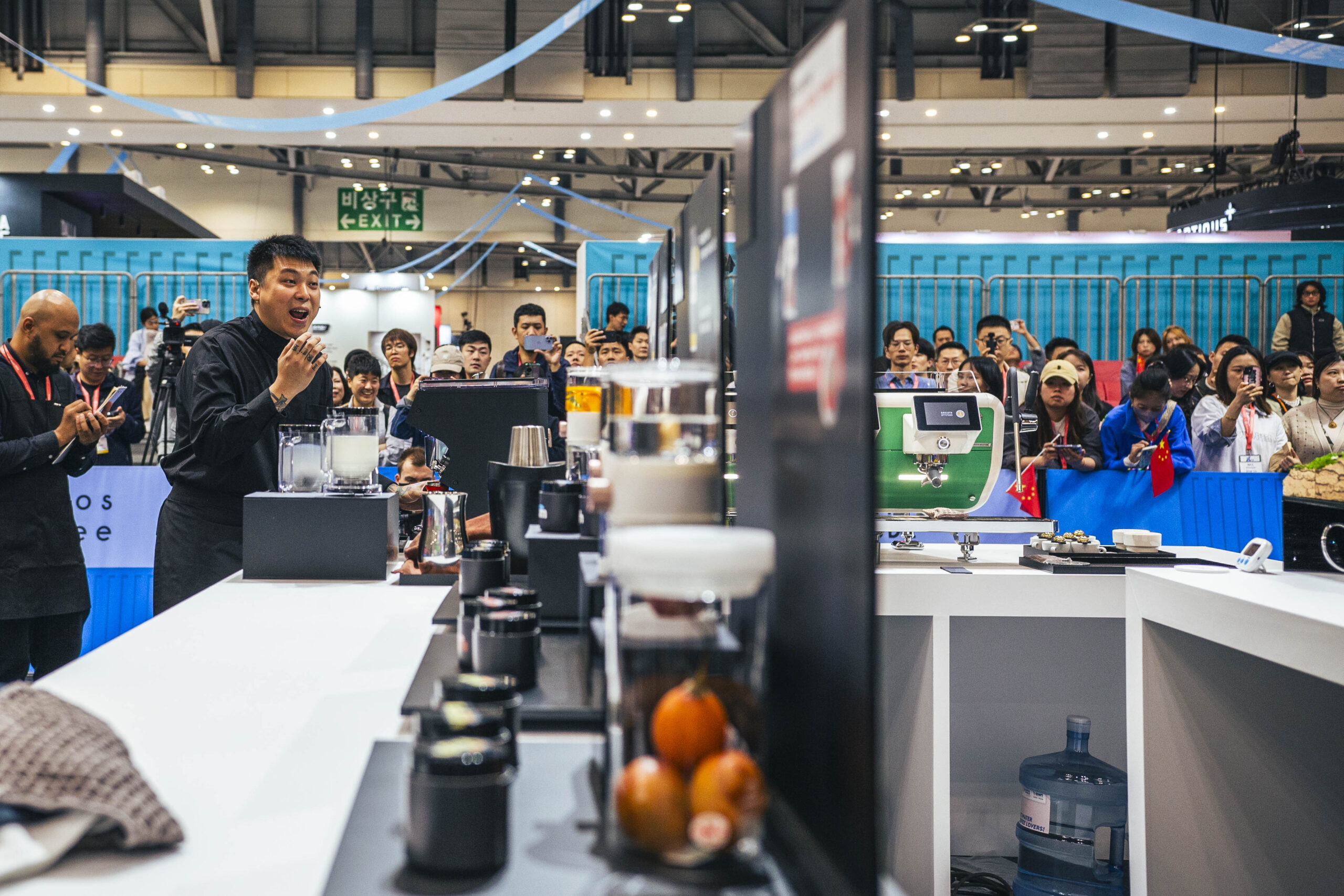
That espresso course gave the judges a long beverage by modern competition standards, a 1:2.5 yield that pushed clarity and texture into the center of the service. The judges saw the real-time shot data during the course. Here, the extraction was part of the room’s attention while the course unfolded.
Pan Wei tightened the espresso recipe to 21g in and 35g out, then paired it with a custom milk blend. The milk component combined freeze-distilled cow’s milk, with 30% of the water content removed, and pistachio milk. The finished milk drink was served at a 1:3 ratio and carried flavors described as cinnamon, single-origin chocolate, and a blueberry finish (Sprudge).
Those details matter because milk drinks at the World Barista Championship are often where a routine can flatten. Pan Wei’s course used concentration as a tool. Removing 30% of the water from the cow’s milk made the milk component denser before pistachio milk entered the blend. The espresso recipe also changed with the course, moving from the wider 20g to 50g Panama Gesha extraction to the tighter 21g to 35g Colombia Gesha extraction.
The espresso course needed orange, peach, florality, tea, weight, and juice. The milk course needed cinnamon, chocolate, and blueberry to survive milk’s fat and sweetness.
Reverse Tamping and the Work Before the Shot
Pan Wei described his puck preparation as ‘reverse tamping.’ The grounds were first stirred and declumped with WDT, then put through a vibration process that distributed particles by size, with heavier particles on the bottom and lighter particles on top. The technique put distribution before compression and made particle behavior part of the routine’s argument.
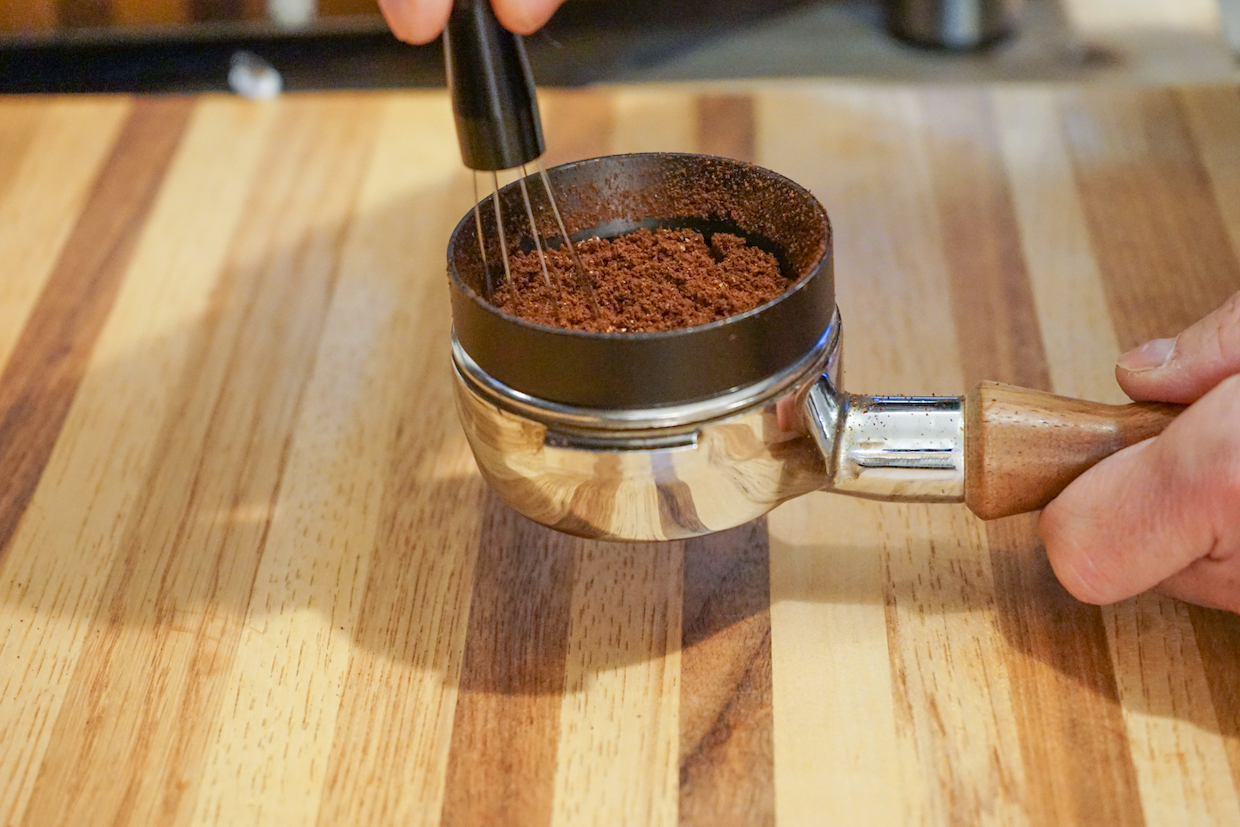
WDT, or Weiss Distribution Technique, has moved from internet coffee forums into serious bar work because it addresses clumping before the tamp. Pan Wei’s additional vibration step made particle distribution part of the judged routine. He was grooming the coffee bed through a prep sequence, and he was sorting density inside the puck before extraction.
The sequence was grind, stir, declump, vibrate, and tamp. The sequence also gave them a language problem. If cafés borrow the phrase without doing the distribution work, the phrase will wear out quickly.
Pan Wei’s approach also sits inside a broader competition habit: turning invisible prep into visible judging material. Distribution usually happens in seconds, with the barista’s body partly blocking the judges’ sightline. In Panama City, Pan Wei slowed that work enough for it to register. Pan Wei’s hands showed why the shot should taste the way he said it would taste.
The method mattered again because the coffees were not forgiving blends built for easy café service. Gesha can read as thin when extracted without enough structure, or lose its floral line when pushed too hard. Pan Wei’s espresso course asked for orange, peach, elderflower florality, green tea, medium weight, and juicy texture from the Panama coffee. The preparation had to support those notes without turning the shot into a lecture. The judges still had to drink it.
The Family Link and the Chilled Espresso Course
Before the signature beverage course, Pan Wei pulled espresso shots and allowed them to cool. He then built a drink called ‘The Family Link’ using elements of the two Geshas. To the chilled Panama Gesha espresso, he added a coffee cherry honey infusion and mosto. He nitrogenated the mixture and combined it with sparkling water.
The finished drink was described as similar to sparkling wine, with notes of lemongrass, apricot soda, coffee blossom, lively mouthfeel, and a grapefruit finish. The construction made the signature course the most openly processed part of the routine. Espresso became an ingredient. Mosto linked the drink back to fermentation. Sparkling water and nitrogenation gave the beverage its texture.
The Panama Gesha had already appeared as espresso. The Colombia Gesha had carried the milk course.
Signature beverages can lose the coffee under additions. Lemongrass, apricot soda, coffee blossom, grapefruit, and lively mouthfeel gave the judges a path through the glass.
Pan Wei had the service time on a competition stage to explain each piece. Mosto-fermented coffee, coffee cherry honey infusion, nitrogenation, and sparkling water can crowd a menu line. At a café counter, the drink would need a shorter route, probably through texture first, then origin. Sparkling, floral, citrus, coffee cherry. The rest can come if the guest asks.
The Finals Field in Panama City
The championship brought 49 Barista Champions to Panama City. Every competitor arrived through a national pathway, with their own coffee, coach structure, routine script, service rhythm, and months of repetition behind them. The WBC stage compresses all of that work into a timed service where one missed step can change the sensory score or the technical score.
Each finalist posted a career-best result. For China, the difference between second in 2025 and first in 2026 will become part of how national competitors read the path forward.
- Champion: Pan Wei, China
- Runner-up: Shing Win, Malaysia
- Third: Frederick Ruben, United Arab Emirates
- Fourth: Gabrel Tan, Australia
- Fifth: Jane Kawinnart, Thailand
- Sixth: Jill Hoff, Canada
Pan Wei’s routine gives working counters several testable pieces. A longer Gesha espresso ratio can show whether the coffee gains juice or loses shape. A bar can try a tighter milk-course recipe and examine how the coffee reads through concentrated milk. A bar can use WDT and vibration, then taste whether particle distribution changes the cup. The championship result does not make those choices universal. It gives working baristas a champion’s version to measure against.
What to Watch After China’s First WBC Title
Reverse tamping moves from competition vocabulary into café workflow. Some baristas will test WDT plus vibration because Pan Wei won with it. Others will keep the idea but drop the name. If the answer is no, the method belongs on the stage, not in the rush.
The second thing to watch is how cafés talk about Gesha by name. That level of naming helps guests understand why a Gesha costs more, why a barista changes the recipe between courses, and why fermentation language appears on a coffee menu. A guest does not need a lecture at 8 a.m., but the counter should be able to answer when someone asks what makes the coffee different.
It includes Jeremy Zhang’s earlier finals presence, Simon SunLei’s second-place finish in 2025, and Pan Wei’s own 27th place in 2024. That sequence gives young competitors a map with failure built into it. A first world appearance can be a calibration, not a verdict.
The Pan Wei World Barista Championship win will matter most if it sends more guests toward the bar with better questions, and more baristas back to the bench with cups to taste side by side.
Frequently Asked Questions
How many times did Pan Wei compete at the World Barista Championship before winning?
He placed 27th at the 2024 World Barista Championship, then returned in 2026 to claim China's first WBC title in Panama City (Sprudge).
What coffee did Pan Wei use for his espresso course at the 2026 World Barista Championship?
He ran the shots at 20g in and 50g out, highlighting notes of orange, peach, elderflower florality, and a green tea finish.
Who placed second and third at the 2026 World Barista Championship?
Shing Win of Malaysia finished as runner-up at the 2026 World Barista Championship, with Frederick Ruben of the United Arab Emirates taking third place. Pan Wei of China won the championship.
What made Pan Wei's milk course unique at the World Barista Championship?
Pan Wei used a custom milk blend combining freeze-distilled cow's milk with 30% water content removed and pistachio milk. He paired this with a tighter espresso recipe of 21g in and 35g out using a mosto-fermented Gesha from Finca Las Flores in Huila, Colombia.
How long has Pan Wei been working in coffee and competing?
Pan Wei has worked in coffee for 12 years and has competed for the same duration. He won the China Barista Championship in 2021 before his World Barista Championship victory in 2026.