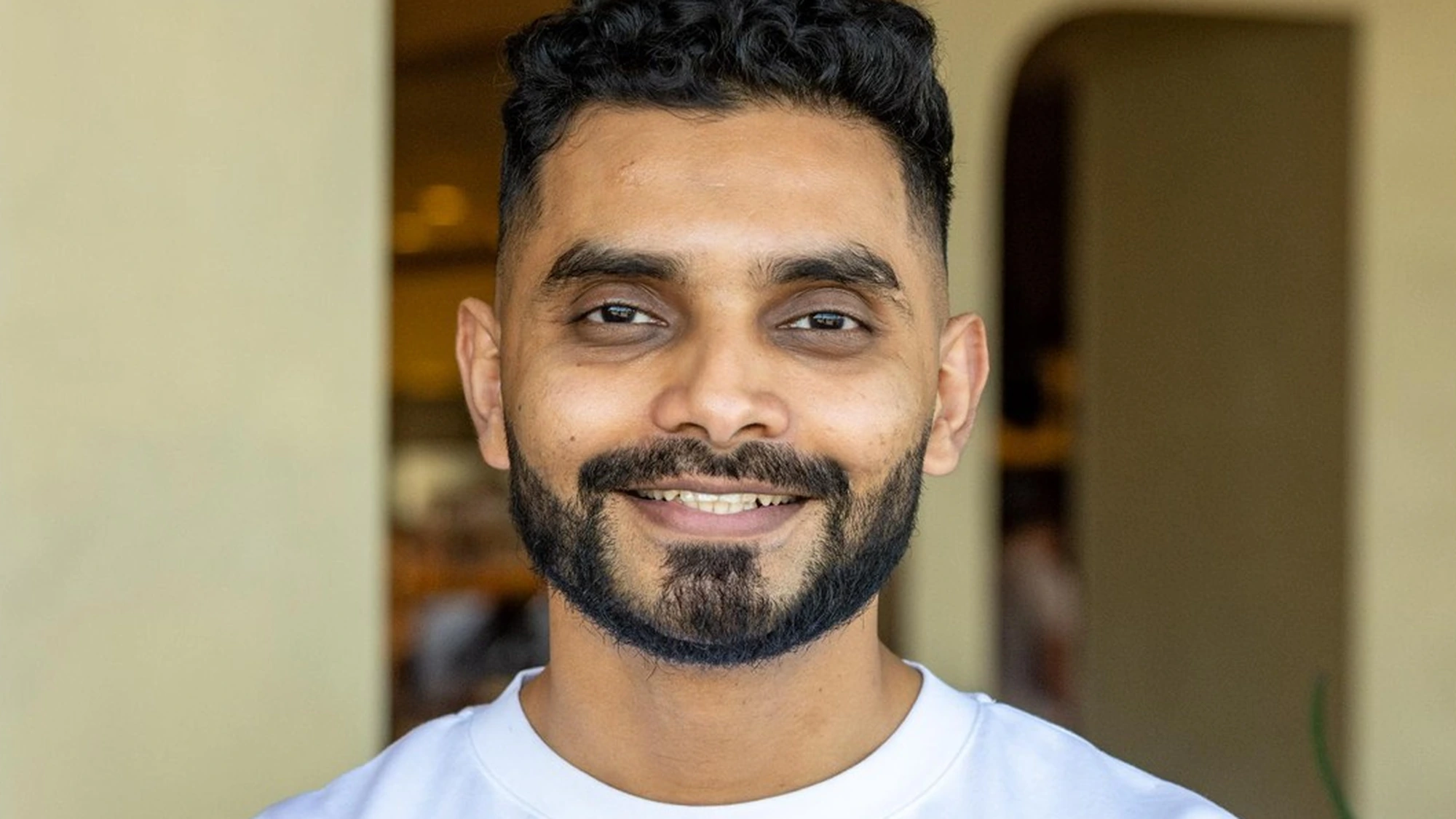
Parachute Bakery opened on September 25, 2025, and sold out 800 items in 90 minutes. Nasir Armar, the pastry chef behind Parachute Bakery in San Francisco, left Saison at the end of April 2025 and built the new bakery around a 10-by-10 workspace inside the Ferry Terminal Building.
The scale is the first thing to understand. Parachute produces about a thousand pastries each day from that compact station, with Armar translating fine-dining habits into bakery repetition. He had run pastry at Saison near China Basin, a restaurant that eventually earned two Michelin stars, before choosing a counter format where trays, timing, lamination, and daily output set the pressure points. The setting changed. The standard traveled with him.
Parachute is not a broad life-reset story with croissants attached. It is a bakery problem solved by a chef who had to learn bakery operations quickly after years in plated dessert work. Armar co-owns Parachute with Alex Hong, who operates the sister restaurant Arquet next door.
The Nasir Armar process starts with a smaller station
Nasir Armar’s current work sits between two kinds of precision. One came from fine dining, where a dessert can be built in controlled stages for a table. The other comes from a bakery, where the product has to repeat through a day’s production without the spacious backstage of a restaurant pastry kitchen. At Parachute, the 10-by-10 workspace gives the story its shape because it puts a hard boundary around movement, staging, and output.
He did not simply take plated ideas and put them behind glass. He left Saison, then spent three months in Europe studying bakeries before Parachute opened. His home-base time was divided among Madrid, London, and Copenhagen, and the research count reached 111 bakeries. On a one-day side trip to Paris, he visited 11 bakeries in a single day.
Those numbers are not decoration. They mark the difference between restaurant pastry knowledge and bakery fluency. Armar had to study how bakeries organize doughs, staff, timing, flour decisions, lamination, and repetition. He has said he did not know how a bakery worked, what flour would work, how he should hire, how to make a croissant, or how to laminate for a croissant before taking on the project. Parachute’s opening rush came after that compressed education.
The thing to track at the counter is the croissant. Parachute won the top prize in the Best Croissant in San Francisco contest at the Royal Sonesta Hotel in June, and the opening day sellout gives the pastry a verified demand marker without needing to invent a morning script around it. If you are choosing one item to understand Armar’s bakery move, start there because the available evidence ties croissant work directly to his learning curve and public recognition.
From Chennai bakeries to San Francisco pastry kitchens
Armar grew up in Chennai, India, where his father owned restaurants, bakeries, and ice cream shops. Before pastry became the route, he wanted to be a pilot. A week in aeronautical engineering school changed that plan. The family example was closer to food than flight, and Armar moved toward kitchens rather than desks.
His early pastry frame widened under Girish Nayak, a chef described as a veteran of kitchens at Jean Georges and Le Bernardin. Armar worked in India and Singapore before moving to California. That sequence matters because Parachute is not the first time he has crossed formats, cities, or kitchen cultures. It is the newest version of that pattern, this time with a retail bakery as the test.
In California, Armar first joined Alex Hong as pastry chef at Sorrel in Laurel Heights. He later took over the pastry kitchen at Saison near San Francisco’s China Basin. Saison’s reputation came with fire as part of the restaurant’s cooking language, and Armar’s desserts there used smoke, heat, and tableside sequencing rather than bakery display rhythm.
Two Saison desserts show the kind of thinking he carried before Parachute. One was an elevated s’mores dessert built around almond wood coals, pine-scented alcohol, frozen marshmallows with white chocolate ganache infused with pine, chocolate, graham crackers, warm chicory foam, and graham cracker ice cream.
Another used tobacco leaves candied over weeks, a brown butter warm mousse, date cake grilled as the dessert was fired, pickled dates with blackberry liqueur and brown rice vinegar, and smoked tonka bean ice cream. These are not Parachute menu notes. They show the level of assembly Armar had practiced before he put his hands to bakery repetition.
How Parachute Bakery organizes fine-dining habits
Parachute Bakery asks Armar to apply restaurant discipline to a different sequence. Fine dining can give pastry chefs long arcs, component by component, then a finished plate. A bakery compresses the work into batches, display, sell-through, and the practical consequences of how much space a tray occupies. Parachute’s thousand-pastry daily figure makes that compression visible.
Armar’s own philosophy has several repeated terms: gratitude, calculated risk, constant learning, seasonality, fine-dining-level precision, and making every bite complete. The last phrase belongs naturally to pastry because a bakery item has fewer chances to explain itself than a multi-part tasting menu dessert. A croissant, entremet, or filled pastry has to carry its structure in the bite rather than in a server’s long introduction.
That is where the fine-dining background becomes useful without turning Parachute into a restaurant in disguise. At Saison, Armar had worked with multi-part desserts that unfolded over time. At Parachute, the work has to survive the daily bakery frame. The source material does not give dough formulas, hydration percentages, butter brands, proof times, or bake temperatures, so the honest read stays with the reported process: Armar studied bakeries across Europe, learned lamination as part of the transition, and opened with enough product to sell 800 items in 90 minutes.
The Ferry Terminal Building location also adds a visible production contrast. Outside the kitchen, the building sits along San Francisco’s waterfront. Inside, the bakery’s station is described by its 10-by-10 dimension and daily output. That is the split Armar has chosen: a public San Francisco address with a workstation that demands close packing, repeated motion, and decisions made around limited square footage.
The illness that changed the risk calculation
Armar’s move out of fine dining did not happen only because of career restlessness. He discovered a life-changing illness and was hospitalized for 2 1/2 months. He does not discuss the particulars. He does say he practices gratitude every day.
That detail should not be stretched into a sentimental bakery origin myth. It is enough to say that the illness changed how Armar weighed work, time, and opportunity. He had been thinking his time in fine dining was running its course. After the hospitalization, Hong contacted him about opening a companion gelateria or bakery with Arquet. Armar was ready to consider a new direction.
The decision carried real craft risk. Armar had a strong restaurant pastry résumé, but he has been direct about what he did not yet know: bakery operations, flour choices, hiring for the format, croissant making, and lamination. Those are not minor gaps. In a bakery, flour selection, lamination skill, staffing, bench flow, and batch timing can decide whether the counter fills on schedule.
Parachute’s first public proof came on opening day. On September 25, 2025, the bakery sold out 800 items in 90 minutes. That figure does not tell the whole story of the bakery, but it gives a clean first measure of the gap between preparation and demand. It also puts the 111-bakery research trip in context. Armar did not have years to slowly become a baker in public. He studied quickly, opened, and immediately had to meet a San Francisco audience at volume.
What the reported figures show
The core Parachute figures are unusually concrete for a young bakery: a 10-by-10 workspace, about a thousand pastries per day, 800 items sold in 90 minutes on opening day, 111 bakeries visited during a three-month European research trip, and 11 Paris bakeries in one day. Each number points to a different part of the operation.
The workspace figure shows the production constraint. A thousand pastries from a station that small means the bakery cannot rely on generous staging room. The opening sellout shows the first service pressure. The Europe count shows the scale of Armar’s self-directed retraining. The Paris day shows how aggressively he used the trip to compare bakery models in person.
There is also the credential stack. Armar worked as pastry chef at Sorrel in Laurel Heights, then took over the pastry kitchen at Saison. Saison eventually earned two Michelin stars. Parachute then won the top prize in the Best Croissant in San Francisco contest at the Royal Sonesta Hotel in June. For a bakery reader, that sequence matters because it links restaurant precision, bakery study, and a specific pastry award without reducing the bakery to résumé shine.
The bakery is operated by Armar. It works out of the Ferry Terminal Building. It shares a project relationship with Alex Hong and the neighboring Arquet. Its daily production figure is tied to an unusually tight footprint. Those facts give the reader enough to understand the pressure under the pastry case without turning the counter into a myth.
What to watch next from Nasir Armar
Parachute plans a second location targeted for spring and likely in the East Bay. The plan includes expanded production space and retail plans that include chocolates, jams, spreads, and cordials. That next room will show how Armar adapts the Parachute system once the production footprint changes.
The second location is the right forward point because Parachute’s first chapter is defined by constraint. A larger production space can alter what the bakery can make, how much it can hold, and which products can sit alongside the pastries.
For now, Nasir Armar’s Parachute Bakery remains a compact San Francisco case study: a Chennai-raised pastry chef, trained through India, Singapore, Sorrel, and Saison, applying fine-dining precision to daily bakery output from a 10-by-10 workstation. The next confirmed public work is the planned second Parachute location, targeted for spring and likely in the East Bay, where the same pastry discipline will meet a different production room.