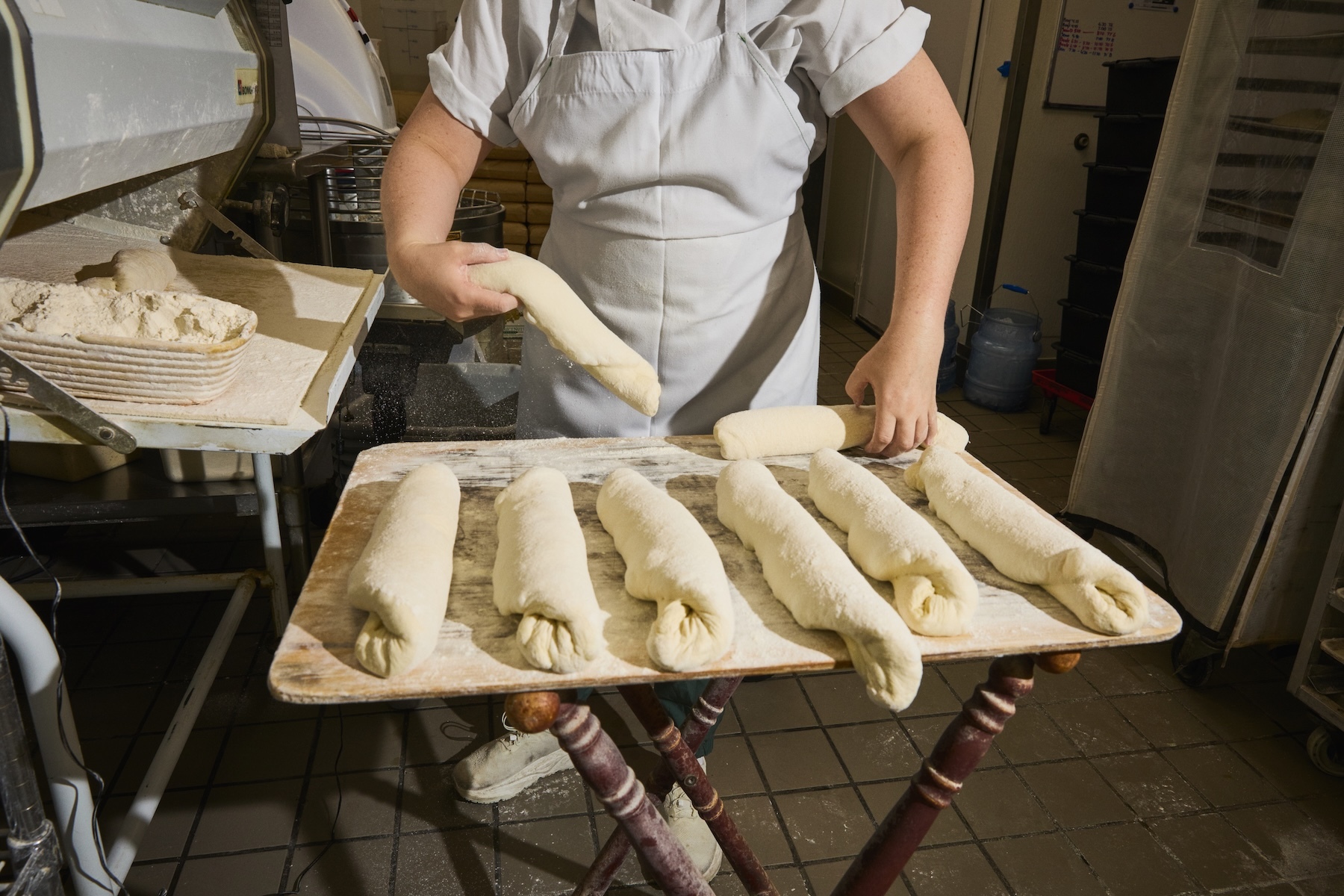
Ariel Einhorn pulls a workbench away from the wall, lets flour fly across its surface, and starts rolling ciabatta dough in the hallway between Parc’s main and prep kitchens, while The Atlantic’s praise for Parc’s cranberry walnut loaf has put a brighter light on the bread leaving that corridor.
Parc Bakery in Philadelphia is the bread department led by Einhorn, producing 2,900 baguettes and 840 sourdough boules in an average week for Stephen Starr restaurants across the city (Resy).
The workspace is a wide corridor with a corner in it, fitted with a three-door oven, a mixing station, moveable racks, and workbenches that shift as the day’s mixing, shaping, and baking schedule moves forward (Resy).
Einhorn wears personalized kitchen whites and a blue apron. Einhorn works in a hallway that functions like a production floor. Flour lands where the ciabatta needs it. The bench comes away from the wall because the dough needs space. A rack moves because bread is due somewhere else in the Starr system.
Parc is a French bistro in Philadelphia owned by Stephen Starr, and its bakery has become the bread hub for several of his restaurants. Borromini, Barclay Prime, and The Dandelion Pub all receive bread from this compact operation. The Atlantic named Parc’s cranberry walnut loaf “the best free restaurant bread in America.” Einhorn keeps working.
Parc’s Philadelphia hallway bakery for baguettes
Parc’s bakery works in a wide hallway that corners between the bistro’s main kitchen and prep kitchen. The bakery has a three-door oven and a mixing station. The workbenches and racks move to meet the schedule.
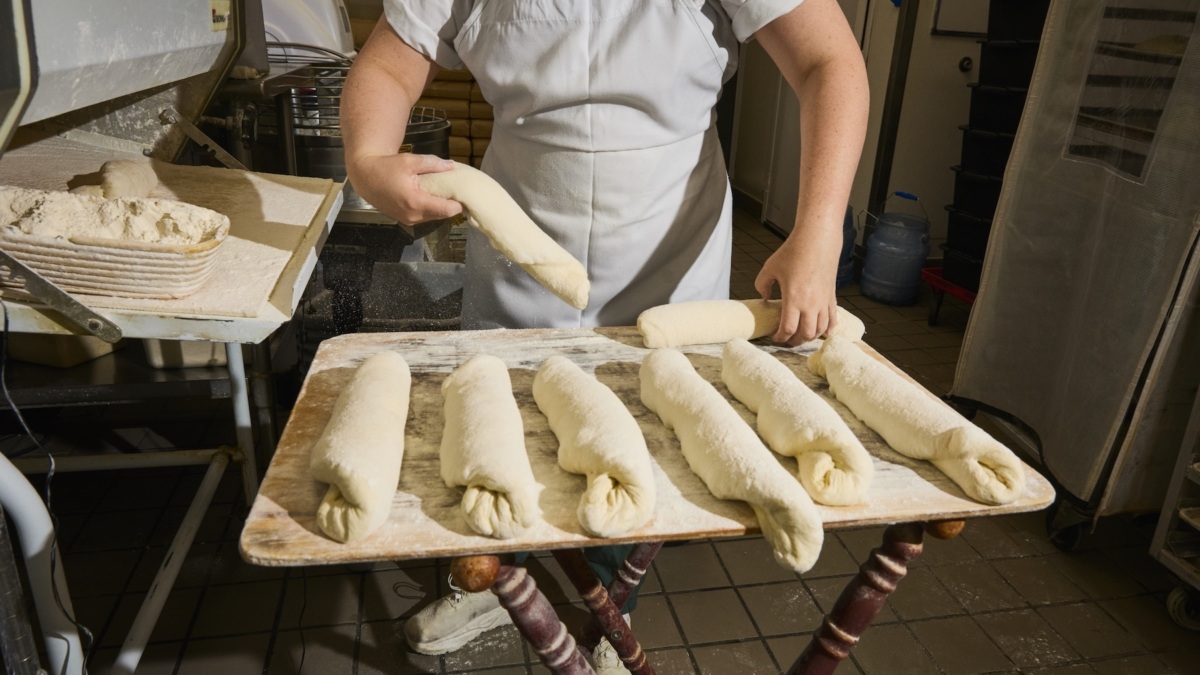
The hallway puts the baker’s day inside the restaurant’s internal traffic. The hallway carries bread work and kitchen movement at once. Wasted steps slow the recipe in a space like that. Efficiency comes from a workbench that can be pulled out, a rack that can be repositioned, and an oven close enough to keep the baking sequence moving.
The weekly numbers give the hallway its scale. During an average week, the Parc bakery produces 2,900 baguettes and 840 sourdough boules. Its production also includes cranberry walnut loaves, semolina rolls, burger buns, slider buns, brioche Pullman loaves, ciabatta rolls, country white loaves, beer bread, Dandelion brioche, buttermilk loaves, pistachio cherry loaves, seed bread, Pugliese rolls, whole wheat sandwich loaves, and bread of the day pieces. Each bread goes to a restaurant in the group (Resy).
The 2,900 baguettes show the scale of the operation. Two thousand nine hundred baguettes means a repeated cycle of mixing, dividing, shaping, baking, cooling, and moving bread through a hallway without slowing the bistro around it. Ciabatta needs a different bench setup. Burger buns need consistency because they have to meet a patty the same way every time.
Ariel Einhorn’s Bench Work
Einhorn leads the bakery department at Parc, and she pulls the bench from the wall before the ciabatta comes out under her hands. Pulling the bench from the wall shows the bakery in miniature. She makes the space available for the dough in front of her.
Ciabatta tells on a baker by how much flour it needs on the bench. Ciabatta needs enough flour on the bench to keep the dough moving, and too much flour can change the eating. The flour is in the air, the dough is being rolled, and a work surface is cleared by hand. Einhorn does not pause over the attention that has landed on the bakery. She gets messy because the dough asks for contact.
The bakery produces thousands of pieces each week. Bread still passes through someone's reach, timing, and judgment. The hallway holds a three-door oven and racks, and the day depends on the person deciding when the dough is ready for the next step.
Executive chef Eric Starkman explains the department’s place inside Parc plainly.
“Parc would not be Parc without Ariel’s bakery department.”
At Parc, bread comes before the guest studies the rest of the meal. Bread sets the pace at the table. It fills the pause after seating. It shows that the kitchen treats the first bite as part of service. At Parc, Starkman ties the restaurant’s identity to Einhorn’s department.
From Parc to Borromini, Barclay Prime, and The Dandelion Pub
The hallway bakery feeds Parc first, then reaches across the Starr group in Philadelphia. Borromini, an Italian eatery, receives bread from Parc. Barclay Prime, a modern steakhouse, receives bread from Parc. Each restaurant asks bread to do different work, and the Parc bakery has to answer without flattening everything into one house loaf.
Burger buns and slider buns have to be built for structure. Dandelion brioche is made for The Dandelion Pub. Beer bread, Pugliese rolls, ciabatta rolls, and whole wheat sandwich loaves all go to different uses before they ever leave the hallway. The bakery makes them under one department head, then sends them into rooms with different menus and service rhythms.
This is the quiet machinery behind a restaurant group, and the stakes are practical. If a rack is late, bread waits in the wrong place. If a bench stays against the wall, ciabatta has no room. If the three-door oven loses its sequence, the hallway loses the timing that lets Parc, Borromini, Barclay Prime, and The Dandelion Pub receive bread from the same department.
Bread determines the first chew, the crust on a sandwich, the softness around a burger, the density of a slice used to hold sauce, butter, or meat.
Parc Bakery gives the group a shared craft center. The bread leaves for different dining rooms and begins under one bakery department. That matters for consistency. A baguette made for Parc and bread made for another Starr restaurant can be scheduled through the same oven rhythm, handled by the same team, and adjusted inside the same working culture when something needs correction.
Stephen Starr’s System, Seen Through Bread
Stephen Starr’s path to this kind of restaurant infrastructure began outside restaurant kitchens. He was born in Philadelphia and grew up in Woodbury Heights, New Jersey, where he attended Gateway Regional High School. He later attended the School of Media and Communication at Temple University in Philadelphia. Before STARR Restaurants existed, Starr opened Grandmom Minnie’s, a diner and comedy club in Philadelphia’s Old City.
The timeline that followed runs through entertainment before restaurants. Starr opened the cabaret Stars on September 16, 1977. In March 1981, he opened Ripley Music Hall, a concert venue and disco. In February 1984, he founded The Concert Company. Those rooms and productions belong to a different trade than bread and help explain the later restaurant group’s dependence on timing, movement, and guest sequence. A show fails if the doors, talent, room, and schedule do not meet at the right moment. A restaurant service has its own version of that pressure (Wikipedia).
Starr founded STARR Restaurants in 1995 and opened Continental Restaurant & Martini Bar in Philadelphia in September of that year. By 2025, the group included 19 restaurants in Philadelphia, nine in New York City, four in Florida, and one location opening in Nashville. It sits inside a company with many dining rooms and still relies on Einhorn’s department for bread that begins in a hallway (Wikipedia).
The awards attached to Starr’s restaurants show the group’s range. Starr won the 2017 Outstanding Restaurateur James Beard Foundation Award. Le Coucou, his restaurant with chef Daniel Rose, was named 2017 Best New Restaurant by the James Beard Foundation. The Clocktower, with chef Jason Atherton, received a Michelin star in the 2018 Michelin Guide. Parc’s bakery belongs to the same operator’s world, and its proof is daily repetition: loaves leaving a hallway for service, week after week (Wikipedia).
What to Watch When Bread Hits the Table
The Atlantic’s description gives the cranberry walnut loaf the clearest public signal among the bakery’s breads and turns free restaurant bread into a named object. The fruit and nuts sit in the crumb. The crust stays present after the loaf leaves the bakery and reaches the dining room. Those details show how well the hallway work survives service.
The baguette is the other measure. A bakery producing 2,900 baguettes in an average week has to make repetition taste intentional. A baguette gives little cover to a baker. The crust, interior, and shape carry the work without inclusions or garnish. At Parc, the baguette also acts as a volume marker, the bread that makes the production number visible.
This is an internal department feeding a bistro and other Starr restaurants. The access is indirect, through the bread that lands at the table and through the knowledge that it began in the working corridor between two kitchens.
The cranberry walnut loaf carries outside recognition. The baguette carries scale. The ciabatta carries the image of Einhorn at the floured bench. The sourdough boule carries the weekly count of 840. Together, they show a bakery department built into the path between prep and service.
Parc’s hallway bakery gives Philadelphia a clear example: one baker-led department, one constrained workspace, multiple dining rooms, and thousands of loaves that leave the oven with jobs already waiting for them.