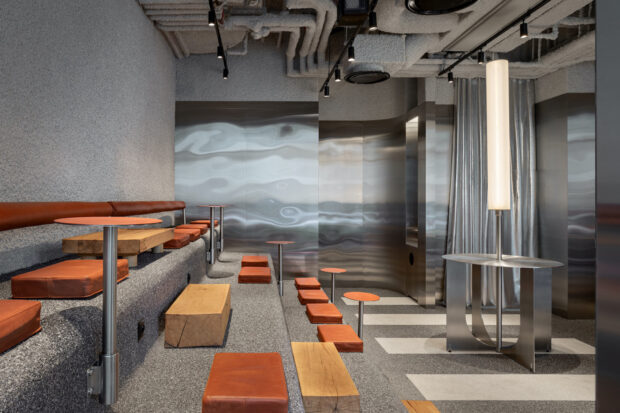
The menu glows on the wall behind a reclaimed-timber bar, and the first decision at the counter is not where to stand but where to stay. DOT Coffee Matcha Warsaw is a 67-square-meter coffee and matcha shop in a former Warsaw power station building, designed by YOD Group and completed in 2025. Large windows pull daylight across stone-carpet flooring, stainless steel, reclaimed wood and the markings of an imagined street (Dailycoffeenews) (Dailycoffeenews).
That is the useful first read on the place. This is not DOT. translated into another small takeaway window. The Warsaw shop is the third location for the DOT. brand, and its brief moves the format toward staying, watching and talking. Coffee and matcha still run through the counter, but the room asks a different question: what happens when the wait is not dead time?
DOT Coffee Matcha Warsaw inside a former power station
DOT. Coffee & Matcha occupies a former power station building in Warsaw, a fact that gives the cafe its first material advantage. The room already has a working past. YOD Group did not erase that industrial charge; the studio placed a compact hospitality program inside it and let the new pieces read as urban equipment.
The project team named for the interior is Volodymyr Nepyivoda, Dmytro Bonesko, Nataliia Tymoshenko and Serhii Prydkyi, with photography by Ivan Avdieienko. The completed space measures 67 square meters, or 721 square feet. In cafe terms, that is not a hall. It is a room that has to make every surface work: floor, ceiling, bar, seating, wall menu, even the pause between ordering and collecting a drink (Dailycoffeenews).
The Warsaw location also changes the brand rhythm. DOT.'s Kyiv locations are oriented mainly toward takeaway, while this Warsaw cafe was designed for people to remain in the room. That shift matters because it changes the job of the interior. A takeaway counter must move bodies through a sequence: enter, order, pay, leave. A stay-focused cafe needs friction in better places. It needs a reason to look up, a reason to sit one level above a stranger, a reason to let a drink take the time it takes.
DOT Coffee Matcha Warsaw makes that argument without adding decorative clutter. The former power station gives the project a shell; YOD Group supplies a set of rules. The result is a small cafe that behaves more like a piece of street furniture than a sealed retail box.
The reclaimed-beam counter sets the working line
The bar is the first piece to understand. Built from reclaimed wooden beams, it serves as the visual anchor of the cafe and contains the coffee machine, matcha station and dessert display. It is not just a service counter. It is the working line, the point where the brand's two main drinks, coffee and matcha, share space with whatever is being selected from the display.
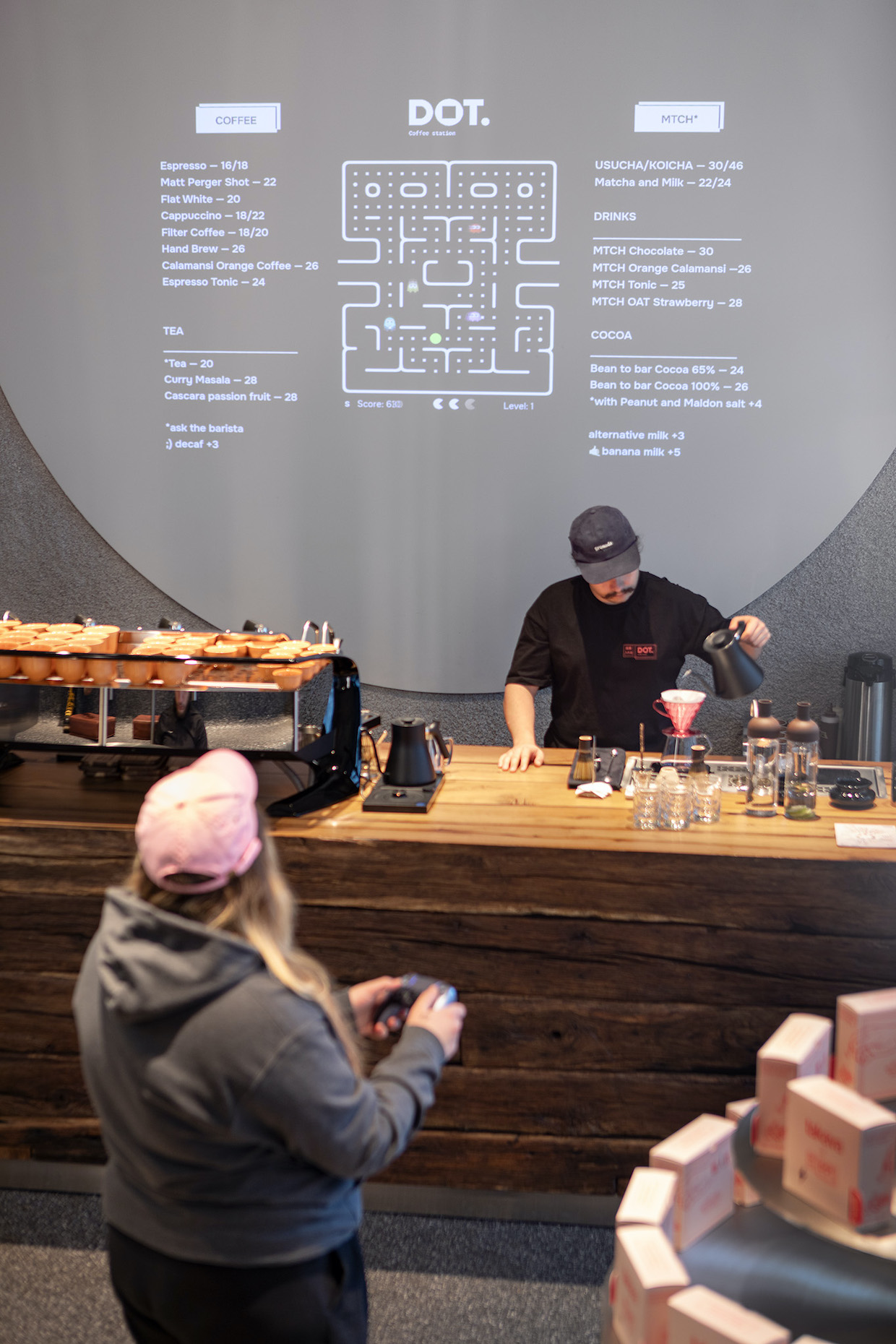
For an Artefice reader, this is the order to make first: choose a matcha if you want to watch the station operate inside the timber counter, or choose coffee if you want to read the room from the bar outward. The published project information does not name the roaster, matcha origin, brew ratios, tea grade or dessert list, so those specifics belong to the counter on the day you visit. Ask who supplied the coffee. Ask how the matcha is prepared. The design makes that conversation easy because the station is not hidden in a back corner.
The menu is projected onto the wall behind the bar, which gives the ordering area a slight transit-terminal feeling. No chalkboard nostalgia. No framed script. The wall becomes an information surface. In a 67-square-meter cafe, that decision saves physical space, but it also matches the urbanism of the rest of the room. Signs, markings, projected instructions, a pedestrian crossing on the floor; the cafe borrows from the language of streets and makes it legible at coffee scale (Dailycoffeenews).
Customers can play Pac-Man while waiting for drinks. That small detail changes the wait from a line into a playable interval. It also keeps the design from becoming too severe. Stainless steel and grey tones can make a cafe feel like a showroom if nobody interrupts them. Here, the interruption is a game, a projected menu, a seat at a different level, a drink being made at the timber bar.
"Within a grey palette," a place to pause
"We wanted to create an interior that reflects the essence of urban life," YOD Group Art Director and Partner Dmytro Bonesko said. "Within a grey palette, rules and markings, people find a place to pause, enjoy warm communication, coffee, matcha and small everyday pleasures."
Bonesko's quote gives the project its clearest operating instruction: rules first, then pause. The cafe's floor resembles asphalt, with markings that suggest a pedestrian crossing in the main room and parking spaces in the restroom. Those marks are not there to imitate a street scene literally. They give the compact room a civic grammar. Cross here. Stop there. Gather on this level. Look across to that one.
The material palette stays tight: stone-carpet flooring, stainless steel and reclaimed wood. Each material carries a job. The flooring sets the street association underfoot. Stainless steel brings the service language of a working counter. Reclaimed wood gives the bar weight and history without having to explain itself. In a former power station, that old timber matters because it does not read as a prop. It belongs to work.
The ceiling has its own task. Acoustic foam covers portions of it to reduce reverberation in the compact shop. That is a practical choice, not a decorative flourish. Coffee equipment, music and conversation can quickly pile up in a small room with hard surfaces. A cafe designed for staying has to handle sound, not just seating. If people are meant to talk across tiered levels, the room cannot turn every grinder burst and cup knock into a wall of noise.
This is where DOT Coffee Matcha Warsaw becomes more than a photographed reuse of an industrial building. The design details answer operating problems: where to put the queue, where to seat a group without a communal table, where to place the drink stations, how to keep sound from hardening, how to make waiting feel less like waiting. The stakes are small in square meters and large in use. A compact room either supports the length of a conversation, or it pushes people back to the pavement.
Tiered seating as a communal table without the table
The seating is the project's social move. A tiered area lets guests sit at different heights, talk and observe the room around them. YOD Group describes the idea as working like a communal table, but without the table itself. That distinction is useful. Communal tables can be efficient, but they also force a kind of togetherness that not every cafe guest wants at 9 a.m. Tiered seating offers proximity without requiring direct participation.
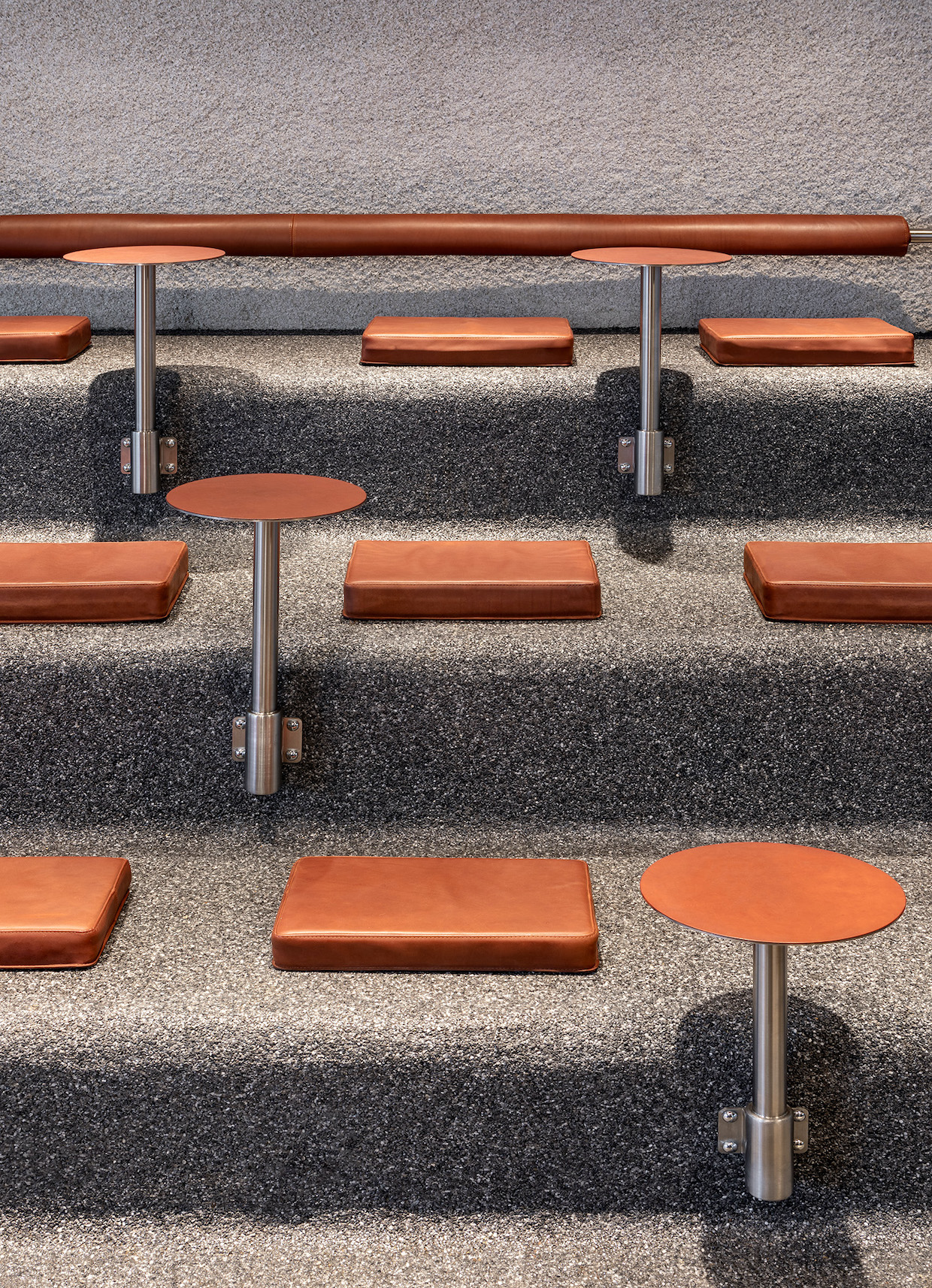
In practice, that means the room can hold several modes at once. Someone can sit alone and watch the bar. Two people can talk across a step. A small group can occupy a level without sealing themselves off from the rest of the cafe. The old power station shell supplies the frame; the tiers create the social topography inside it.
This is also where the Warsaw shop separates itself from the takeaway logic of the Kyiv locations. A takeaway shop measures success in clean handoffs and fast exits. A stay-focused shop measures the distance between the first sip and the decision to leave. DOT.'s Warsaw cafe uses architecture to lengthen that distance. It gives the customer a place to be after the cup lands.
The choice also suits a coffee and matcha program, even without published details on sourcing. Both drinks can be transactional, but both can also reward attention. Matcha has a visible preparation sequence. Espresso has a short, concentrated performance at the machine. Filter coffee, if offered on a given day, asks for more time. The room gives those acts a stage without making them theatrical.
What to look for when you visit
The confirmed public details place DOT. Coffee & Matcha in Warsaw, Poland; street address, daily hours, reservation policy and current menu pricing are not included in the project record. Check DOT.'s current channels before crossing town, especially if you are planning a cafe route around design stops rather than walking in by chance.
When you do go, give yourself enough time to use the room as intended. Order from the projected menu at the reclaimed-beam counter. If matcha is being prepared, watch the station built into the bar. If coffee is your first order, ask the person on bar what they are serving that day, since the available project information does not name a roaster or brew recipe. Then take one of the tiered seats rather than standing near the exit with a takeaway reflex.
Look down before you look around. The floor markings are part of the cafe's structure, not a background graphic. The pedestrian crossing in the main room, the parking references in the restroom, the asphalt association underfoot and the grey palette all pull the former power station toward the street outside. Look up, too. The acoustic foam is there because conversation is part of the program, and the room has been tuned for people to stay.
DOT Coffee Matcha Warsaw points to a useful future for small specialty cafes in reused industrial buildings: less spectacle, more working decisions. A 67-square-meter room cannot afford empty gestures. Here, the counter, the tiers, the ceiling, the projected menu and the Pac-Man wait all do a job, and the former power station gets a second life measured in coffee, matcha and the length of a conversation.