Why go
Green tea folded into French form
Matcha sits in the case as a pastry decision, not a garnish. Sadaharu Aoki, Pastry Chef at Sadaharu Aoki in Luxembourg, Paris, builds the boutique around that kind of contact between Japanese ingredients and French structure. His first technical base came at Machida Cooking School, followed by production work at Patisserie Chandon in Tokyo until 1991. From 1991, he worked in Paris at Jean Millet's and Pierre Couderc's restaurants, then in Switzerland at Frédy Girardet's restaurant, before founding Pâtisserie Sadaharu Aoki Paris in 1998. The Luxembourg boutique belongs to that Paris house, where the hand is most visible in the restraint of the finish: green tea, black sesame, azuki bean, chocolate, butter, cream, and almond made to hold a clean line. Aoki has described his daily standard through the sentence he returns to after praise: “Delicious!" When I hear this from people with their mouths full of my pastries and a smile on their face, I would always say: "Good, but I can do even better!" This is a motto of my everyday life.” That sounds less like a slogan than a bench habit. The cake leaves the hand; the method asks for another pass.
Japanese flavor inside a French frame
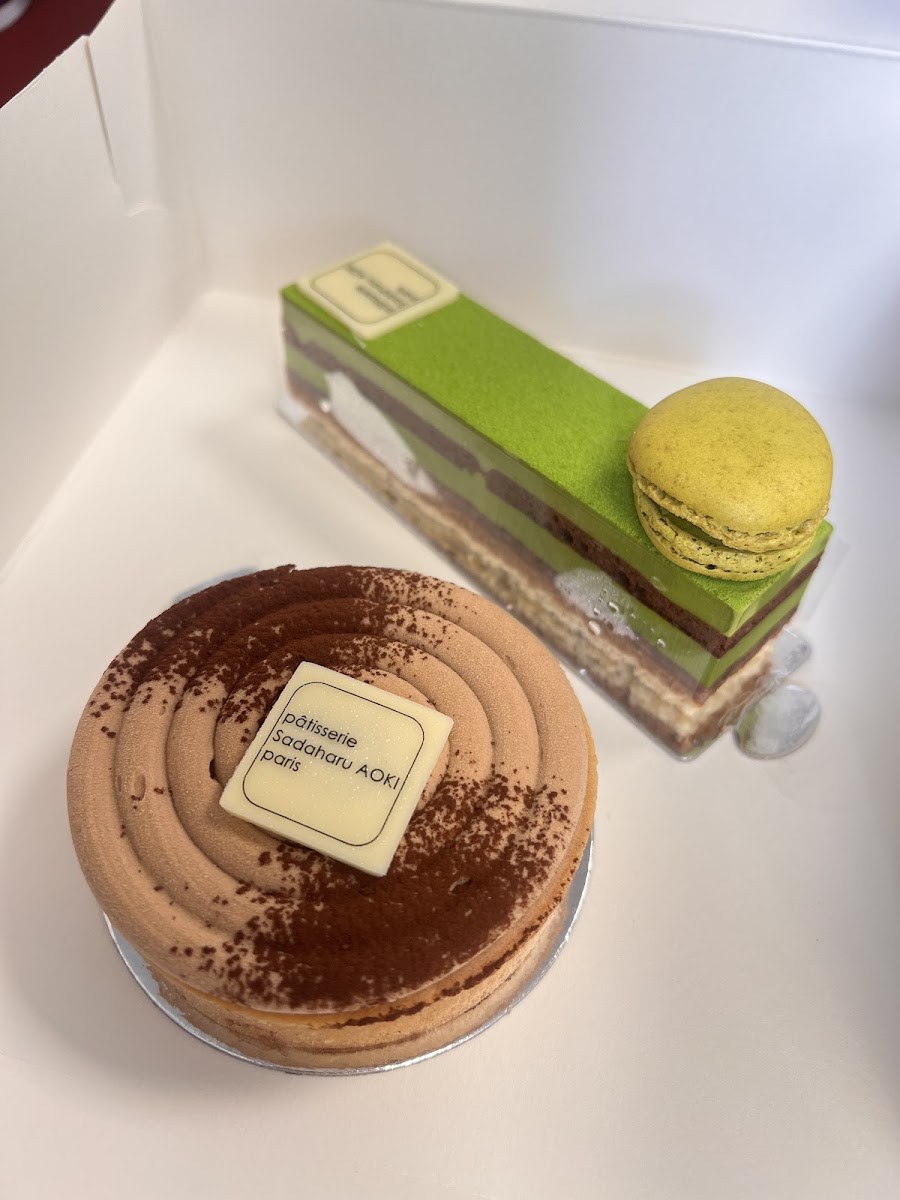
The program here is pâtisserie rather than bread. The house is known for cakes, macarons, chocolates, matcha chocolates, and matcha drinks, with French formats carrying Japanese flavor through the whole structure. Thé Vert Napoléon is the clearest argument: the French millefeuille idea brought into the register of green tea, where the bitterness has to stay clean against cream and pastry. The Chocolate and Salted Butter-Caramel Tart works in a darker range, with caramel and chocolate held inside a cut form. Macarons give the method a smaller scale, where color, shell, filling, and flavor have little room to hide. The work is design-forward, but the design comes from discipline at the bench. Aoki places Japanese visual restraint beside classical French pastry technique, so the case reads in planes, edges, and measured color rather than ornament. The house does not describe the Luxembourg shop as a visible production kitchen; what the guest meets first is the finished pastry, set out for selection at the counter.
The counter as the visible pass
The room is quiet, small, and built around the display case. Finished pieces sit in a clean boutique setting, graphic without noise, each cake carrying its own geometry. At Vaugirard, Port-Royal, Ségur, Saint-Dominique, Malakoff, and the Lafayette Gourmet stand, the Paris presence works as a network of boutiques rather than a single bakery with one public bench. Some addresses include a Salon de Thé, where pastries meet tea or coffee at a slower pace; others keep the exchange closer to the counter. In the Luxembourg shop, that counter is the pass the reader can see. The pastry has already taken its time elsewhere, in mixing, setting, glazing, cutting, and boxing. What remains in the room is selection, a short exchange, and the weight of a finished gâteau leaving the case.
A house built on transmission
Aoki's work has also moved outside the boutique through his role as food consultant for Yumeiro Pâtissière, a manga built around pastry knowledge. Peer recognition came in 2011, when he received the title of Patissier of the Year. At the shop, the more durable record is the continued making of a house language: French pastry forms, Japanese ingredients, and a visual discipline that returns, again and again, to Thé Vert Napoléon.