Why go
Matcha held inside French form
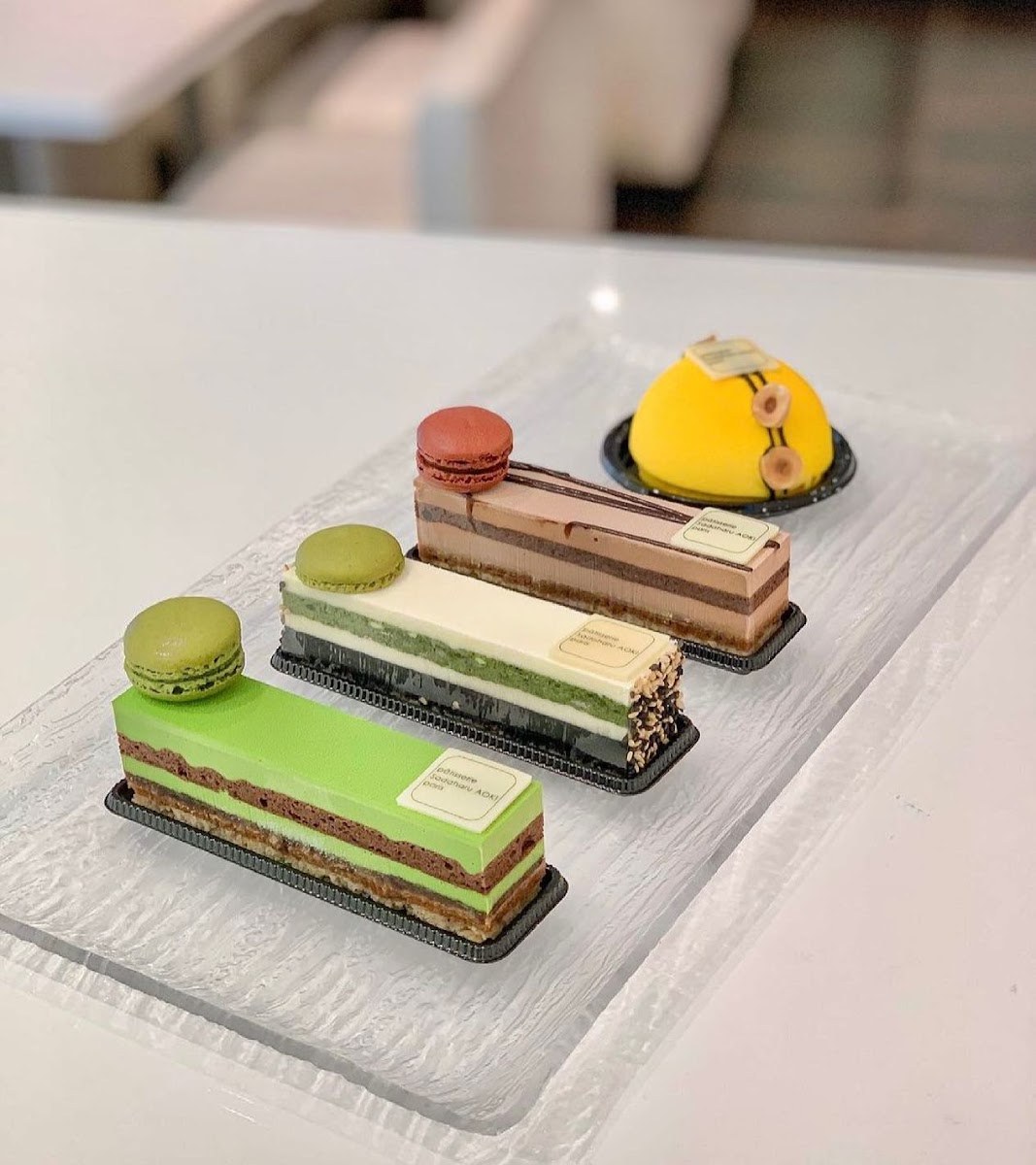
Green tea sits in the case as structure, not tint. Sadaharu Aoki, Pastry Chef at Sadaharu Aoki in Paris, builds his pâtisserie around that decision, carrying Japanese ingredients through French forms with a restraint that belongs to both traditions. At the boutique on Rue de Vaugirard, near Luxembourg and Saint-Placide, the work reads in clean lines: an opéra cake made as Bamboo with matcha tea, black sesame carried through an éclair, azuki set into the curve of Dôme Matcha Azuki.
Aoki’s first pastry training came at Machida Cooking School, before production work at Patisserie Chandon in Tokyo until 1991. From 1991, Paris supplied the next layer, through posts at Jean Millet's and Pierre Couderc's restaurants; Switzerland followed at Frédy Girardet's restaurant. He founded Pâtisserie Sadaharu Aoki Paris in 1998, and the practice has stayed close to that founding grammar: Japanese taste, French technique, controlled finish. His own motto keeps the bench moving after praise has landed: “Delicious!" When I hear this from people with their mouths full of my pastries and a smile on their face, I would always say: "Good, but I can do even better!" This is a motto of my everyday life.”
The case as the working surface
This is a pâtisserie before it is a bakery in the bread sense. The program centers on cakes, éclairs, macarons, chocolates, and matcha sweets, with French formats carrying ingredients more often associated with wagashi. Bamboo gives the method away: the opéra structure remains legible, but the register shifts through matcha. The black sesame éclair does the same work in a shorter form, relying on choux, filling, glaze, and a flavor that changes the expectation without loosening the discipline.
The house does not describe the branch as a boulangerie, and the published language around it stays with gâteaux, boutiques, and the Salon de Thé. That distinction matters. The bench here is not organized around loaves or a morning bread run; it is organized around finished pastry, cut edges, set creams, chocolate, tea, and the clean visual field that Aoki has made part of his signature. Macarons sit beside the larger cakes as small tests of the same method. Nothing in the case needs to announce fusion. The ingredients do the quieter work.
A quiet boutique near Luxembourg
The room at 35 Rue de Vaugirard has the scale of a specialty boutique, with the Salon de Thé extending the counter into a slower kind of service. It is dessert-forward rather than expansive, built for looking closely before choosing. In a quiet shop, the case carries most of the conversation: green, black, cream, gloss, the sharp geometry of layered cake, the rounded shell of a macaron, the dark line of sesame inside an éclair.
That atmosphere suits the craft. Aoki’s pastries ask for attention to proportion, not abundance. Japanese visual restraint and French dessert structure meet at the point where a slice holds its edge and a flavor stays clear. The Paris shop is one part of a wider house with boutiques in Japan, but Rue de Vaugirard remains the European address where the method is encountered at counter height.
Recognition without a louder voice
Peer recognition came in 2011, when Aoki received the title of Patissier of the Year. The pastry had to change little to absorb that attention. The work still returns to the same bench-side questions: how much matcha a French form can carry, how black sesame behaves in an éclair, how azuki changes the finish of a dome. The object in the case is the Bamboo at Sadaharu Aoki.