Why go
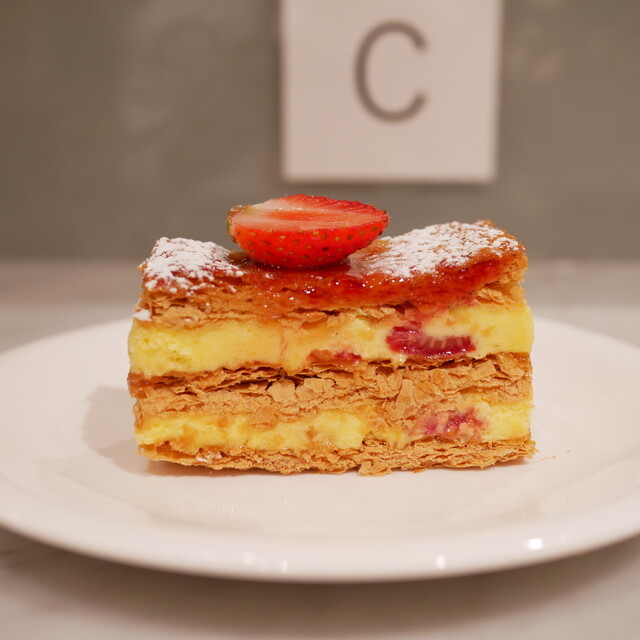
Below Shinjuku’s churn, the basement food floor changes the city’s volume. Train-station haste gives way to glass cases, gift boxes, paper bags, and the choreography of Tokyo depachika shopping. Patisserie belongs to that world: not a destination dining room or lingering café, but a cake counter for decisions made under bright department-store lighting and carried into the day.
Tokyo’s sweets culture has long treated department stores as serious stages. The depachika is where patisserie, wagashi, bakery counters, prepared foods, and edible gifts compete in compressed retail theatre. In Shinjuku, that theatre has extra force because the station area absorbs office workers, domestic travellers, families, and visitors crossing between rail lines. A counter here is judged on craft, speed, presentation, transportability, and how well it survives gifting etiquette.
Shinjuku's basement sweets culture rewards precision over ceremony
The format’s point is focus. A takeaway-specialist counter removes the rituals of Tokyo’s high-end dining rooms: no seat pacing, chef-led sequence, wine pairing, or hospitality theatre. What remains is Tokyo’s severe retail test: can a sweet look composed, travel cleanly, and justify a stop in a building filled with alternatives?
Patisserie’s inclusion in Tabelog 100 Sweets Tokyo 2023 places it in a competitive citywide sweets conversation, not just a convenient station-adjacent purchase. Tabelog’s sweets lists matter in Japan because small differences in execution, consistency, and local loyalty separate a routine counter from one drawing repeat attention. Its listed score of 3.75 reinforces that this is not merely department-store traffic doing the work.
The location shapes the experience. Sendagaya’s address line may read calmer than Shinjuku’s reputation, but the New South Exit zone is effectively part of the city’s transit engine. This is Tokyo practical luxury: cakes bought between errands, before a train, after shopping, or on the way to someone’s home. Unlike a destination patisserie in a residential quarter, it is less about making an afternoon of it than fitting serious sweets into a city that rarely grants empty time.
That distinction matters for readers mapping Tokyo through food. A sushi counter in Ginza asks for advance planning and concentration; a depachika cake counter asks for timing, decisiveness, and an understanding of how Tokyo consumes quality on the move. Nearby department-store and station-area sweets counters such as Toranomon Okanoeisen Shinjuku takashimaya ten, Pan Chela Shinjuku takashimaya ten, Toraya An Stand Shinjuku ten, and Le Pan de Joël Robuchon Nyuuman shinjuku ten sit in the same retail ecosystem, where brand memory, portability, and occasion drive purchase as much as appetite.
A cake counter, not a café, changes the reader's expectations
The category is cake, and the service model is take-out. That fact recalibrates expectations. Tokyo has dessert rooms built around lingering, but this is closer to the city’s high-functioning gift economy: select, pay, carry, serve elsewhere. The lack of seating is not a deficiency. It is depachika grammar, where quality leaves the building in a box.
For international visitors, the lesson is useful. Tokyo’s food reputation is often filtered through reservation-only counters and tasting menus, but some of its sharpest everyday standards sit in retail floors and station corridors. The city that supports formal kaiseki and omakase also expects a cake counter to handle presentation, packaging, payment, and pacing with discipline. A sweets stop in Shinjuku can reveal as much about Tokyo as a longer meal.
The surrounding Shinjuku grid broadens the choice set quickly. A diner building a day around the area could pair sweets shopping with something more casual or savoury elsewhere, from 12/10 Shinjuku ten to Tsukemen Gonokami Seisakujo, or move farther across the city through Our full Tokyo restaurants guide. For a more itinerary-led view, EP Club’s Tokyo coverage also separates the city by stay, drinking, wine, and cultural planning through Our full Tokyo hotels guide, Our full Tokyo bars guide, Our full Tokyo wineries guide, and Our full Tokyo experiences guide.
Within the wider Tokyo dining map, Patisserie is better understood as a high-convenience sweets marker than a chef-driven restaurant narrative. It suits travellers who read department stores as cultural infrastructure, not shopping detours. The counter also shows that Tokyo’s lower-cost food moments can carry editorial weight when the format is disciplined and the setting competitive.
How to read it against Tokyo's broader food map
Tokyo’s range can make small-format sweets feel minor beside famous counters, but the better comparison is with the city’s everyday specialist network: curry shops, cafés, yakitori counters, seafood izakaya, and station-area food halls that solve narrow problems with speed. On that spectrum, the Shinjuku depachika cake counter occupies the gift-and-dessert lane with unusual efficiency.
Readers building a broader Japan food itinerary can use this as a calibration point. The same editorial logic that makes 3 Chome no Curry Ya San useful for curry context, 124. KAGURAZAKA (Yakitori) useful for skewers, or. 鮪と炭火焼き うお炭 秋葉原店 useful for tuna and charcoal cooking also applies here: narrow formats reveal how a city eats when it is not performing for visitors.
There is also value in seeing how Tokyo’s casual and visual food culture branches outward. 2D Cafe plays a different role, built around a graphic room concept rather than department-store gifting. Farther afield, -Grilled beef Sukiyaki- KAMAKURA TANUKIAN 鎌倉 たぬき庵 in Kamakura,.cafe in Osaka,.know in Kumamoto, (Shoku) Vietnam in Kawasaki, [Curry Senmon Ten] Maruyama Kyoju. in Sapporo, and [ki:] in Kyoto show how regional context shifts the meaning of a compact food stop. Across the Pacific, Jōdo Saké Bar in Los Angeles and Onigiri Time in Pasadena extend the Japanese-format conversation into diaspora dining.
The editorial read is clear: Patisserie is strongest as a Shinjuku place study. Its recognition, cake category, and takeaway-only structure align with Tokyo’s habit of putting exacting food inside transport-heavy retail environments. Go to understand the depachika as a serious sweets arena, not to search for a long-form restaurant experience.